
Measuring the Determinants of Consumer Perception Regarding Mobile Advertising in Pakistan: A Comparison between private and public sector universities
Farhina Hameed1*, Hina Rehman2, Younus Awan3
Farhina Hameed, Hina Rehman & Younus Awan. (2016). Measuring the determinants of consumer perception regarding mobile advertising in Pakistan: A comparison between private and public sector universities. Science International, 28(1), 735-741
ABSTRACT: Mobile communication devices have provided tremendous opportunities and this study explored basic factors that can affect customer perception regarding mobile advertising. Secondly, the impact of advertising value and attitude towards advertising on purchase intention is explored and both variables are examined as mediators. Twin cities of Pakistan i.e. Rawalpindi and Islamabad are considered as target geographical regions and 326 students belonging to Public and Private Sector Universities are taken as a sample. A systematic sampling technique is used to collect responses and Structural Equation Modeling (SEM) technique is conducted to evaluate the results. The results indicated Infotainment and Credibility of source are the determinants of consumer perceptions whereas Irritation has insignificant impact. Theoretical and practical implications of findings are discussed.
Keywords: credibility, infotainment, mobile advertising, Pakistan
Introduction
Mobile phones are now utilized as a multipurpose entertainment gadget. These handsets are within the reach of
almost every person and helps in communication throughout the world. Marketers have identified this opportunity and
utilized a unique way for transmitting the desired marketing content [1]. Mobile marketing allows the marketers to
transmit the messages directly to mobile phones and facilitates in developing long term relationships. In this regard, Short Messaging Services (SMS) are used to access the customers by means of their cellular handsets. There are
several advancements which have proven facilitatior, not only for the customers, but appeared to be opportunistic for
marketers.Among them,technological advancements are evident which have transformed way of living for individuals.
the Communication services are now accessible for everyone and provide fastest way to deliver personal messages. Moreover, it has paved the way for advertisers to access their target market more easily [2]. Several studies
have been conducted for examining the factors that are influential towards consumer behavior and towards mobile
advertising. In the first stage of the research. Lee [3] explored this relationship by adopting a correlational approach. According to the results, negative sentiment was disclosed indicating the ineffectiveness of mobile advertising.
This is the dilemma for companies engaged in practices of mobile advertising because the overall brand image is at
stake. However, in the next stage of study, Lee [3] identified positive perceptions of customers regarding mobile advertising. Favorable attitudes were observed when the intention of the marketer was strong. Hence, it can be stated that for making mobile advertising messages favorable and effective for the customers, it is essential for the marketers to study the determinants of consumer perceptions. It is known that because of increasing usage of mobile phones, companies are utilizing the opportunity to deliver marketing messages. However, the responses of consumers towards mobile advertising method, currently adopted by marketers are unclear. Therefore, the companies cannot assure that their stated objectives are achievable or not. This study is intended to examine determinants of consumer perceptions regarding mobile advertising in Pakistan. For addressing the presented problem, it is important to divide customer perceptions into different measurable variables so that overall impact of perceptions can be analyzed on advertising value and attitude of customers towards advertising. Moreover, whether the attitude is favorable enough to trigger the purchase intention of the customers or not, this is the basic research question which is analyzed in the study. For developing appropriate mobile advertising strategy, the consumer preferences play a very important role. In this paper, determinants of consumer perceptions specifically related to mobile advertising in the context of Pakistan is measured, and overall objective is achieved by adapting the research conducted by Liu, [4]. The basic objective of the study is to explain investigative approach that is used to determine influence of mobile advertising messages in context of Pakistan. The research objectives are: 1. To determine the factors that can affect customer perception regarding mobile advertising. 2. To find out the impact of advertising value and attitude toward advertising on purchase intention. 3. To investigate which factors havepositive impact on advertising value. 4. Multi-group comparison between public and private sector universities to evaluate the impact of infotainment, irritation and credibility on advertising value.
Literature Review and Hypothesis
Mobile advertising is considered as unique by several marketers because it ensures direct contact of marketers with
their customers [5]. Usually the handsets are always turned on because people stay in touch with their friends and family
members, there is an available opportunity for the marketers to deliver their advertising messages. Study conducted by
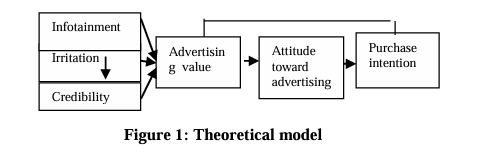
Varnali [6], examined responses of consumers towards mobile advertising. The responses were measured by adopting field experiment approach and the effects of messages on attitudes and behaviors of consumers were studied. The study conducted by Yang [7] developed theoretical foundation of interactive advertising; technology ,acceptance of the users is a fundamental factor that depicts responses of consumers towards mobile advertising. The overall results indicated that mobile advertising positively affects the responses of consumers.Technology acceptance model is presented by Ayanwale [8], so that the theory of planned behavior can be tested. The authors incorporated behavioral and attitudinal variables for measuring customer’s preferences and to determine the relationship between behavior and attitude [9]. Customer’s perception is the attitudinal variable that represents the general behavior of customers towards mobile advertising. Koo [10], described ways to determine customer’s perceptions. It must be studied in detail because these are the ultimate factors that lead customers towards purchase behavior. Infotainment is derived from two words i.e. information and entertainment.Infotainment is developed and the concept was related for determining advertising value. Watson [11] in the online study identified that permission based SMS advertising are the source of information for the users. By seeking permission from the customers, marketers can reduce the level of ignorance, irritation and other negative attributes from the customers. H1: The perceived infotainment of mobile advertising is positively associated with a perceived advertising value. Irritation is associated with negative consequences of mobile advertising [12]. Watson [11] conducted online survey and explained the attitude of customers towards mobile advertising, whether the customers prefer to receive mobile messages or not, consideration of mobile text messages as annoying and tendency to delete the messages just after receiving the text on mobile devices are some of the questions that were asked from them. Most of the people are identified to be irritated as a result of SMS advertising. H2: The irritation felt as a result of mobile advertising is negatively associated with a perceived advertising value. Credibility refers to the trustworthiness and belief of the customers that marketers are being honest with them. McCole [13] examined the attitude of customers towards advertising. There are several privacy and security concerns which are faced by users in this digital age. People will only show a positive attitude towards advertising messages if they are from credible and trustworthy sources. Yang [7] supported this argument by describing the interactive nature of mobiles. The results reveal that credibility was identified to be the major variable for determining the attitude towards mobile advertising. The extensive research on mobile marketing and mobile marketing was analyzed from the perspectives of theoretical frameworks, strategies, consumer behavior and public policy. H3: The perceived credibility of mobile advertising is positively associated with a perceived advertising value. Advertising value is considered as subjective evaluation of utility or relative worth of advertising towards the customers [4]. Advertising value helps in determining the worth of specific advertisement for the customers. It indicates that ability of advertisement to provide relevant information is the core reason for approval or disapproval of products. Mobile messages are very instant to read and provide interconnectivitytowards variety of communities. Hyun [14] explained that advertising affects the behavioral responses of
the customers. But it is important to take into account different dimensions which stimulate emotional responses
within the customers. H4: A consumer’s perception that advertising has a high value is positively associated with attitude towards mobile advertising.
H5: A consumer’s perception that advertising has a high value is positively associated with purchase intention. Perceived value is considered as determinant of customer’s attitude towards advertising and it is identified that if the customers perceive value in any advertising content, they show positive attitude towards advertising. Behavioral intentions and personal innovativeness were studied on the basis of theory acceptance model, theory of planned behavior and diffusion of innovation theory. Pyun [15] explained advertising objectives to develop successful advertising campaigns that facilitate the companies in getting favorable attitude. It was supported by different researches that belief factors are most significant in order to determine customer’s attitudes.
H6: The attitude toward mobile advertising is positively associated with positive purchase intention of consumers. Customer purchase intentions reveal a stage before final decision of customers towards the purchase of any product and service. Intentions reveal whether the consumers are inclined towards the purchase of product or service or not [1]. Lee [16] conducted an online review and link was established between trustworthiness of source and customers’ purchase intentions.
Hypotheses for multi-group comparison
H7a. The effect of infotainment on advertising value is greater for private sector universities than in public sector universities.
H7b. The effect of irritation on advertising value is greater for private sector universities than in public sector universities.
H7c. The effect of credibility on advertising value is greater for private sector universities than in public sector universities.
The gap identified that advertising value affect attitude toward advertising, but does it have an impact on purchase
intention. Many studies have identified factor in future directions [4]. The study adds knowledge to the existing body
of literature by examining new variable: purchase intention, the effect of positive attitude toward advertising affect purchase intention of customers. Moreover, the direct impact of advertising value on purchase intention is explored. The
model is adapted from the study of Liu [4]. It examines the ways by which customers develop positive or negative attitudes towards mobile advertising. Research conducted by Liu [4]. The model is extended by adding another variable that is purchase intention [17]. As a result, the collective impact of infotainment, irritation, credibility, advertising value and attitude towards advertising is checked with respect to customer’s purchase intention. Moreover, a new relationship is also explored between advertising value and purchase intention.
Methods
Nineteen items are distributed amongst the target variables of the study. 5 of infotainment, 2 of irritation and 3 of advertising value is adapted from [18], 3 of credibility adapted from [19]. 3 of attitude toward advertising, adapted
from the study of [20] whereas 3 of purchase intention , adapted from [21,22,23]. Likert scale is used for measurement of responses. The population is university students of Rawalpindi and Islamabad. There are total fourteen public sector universities and eight private sector universities. From these, four universities are selected from each sector. Systematic sampling technique is executed. Total 500 respondents are selected, 250 from each sector and out of 500, 326 were received back. The response rate of study is 65%. Via use of AMOS software, SEM is applied to evaluate results.
Results
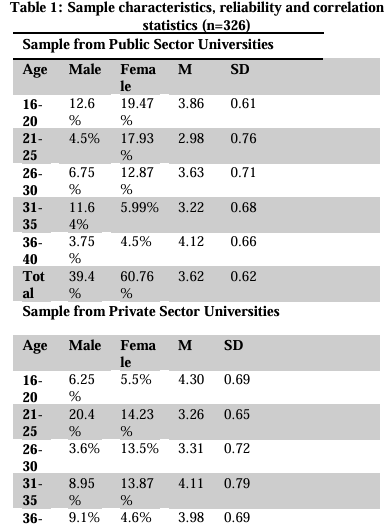
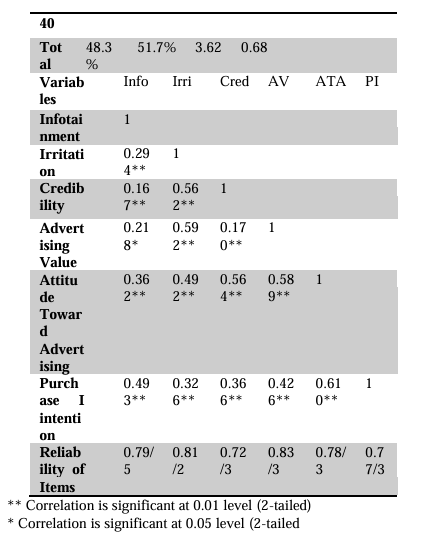
Before analysis, normality of data is checked thus shows data is normally distributed. The value of Cronbach’s alpha for
composite scale is 0.78,therefore, data is reliable. The Pearson correlation is performed to check association among variables of interest.
Confirmatory factor analysis
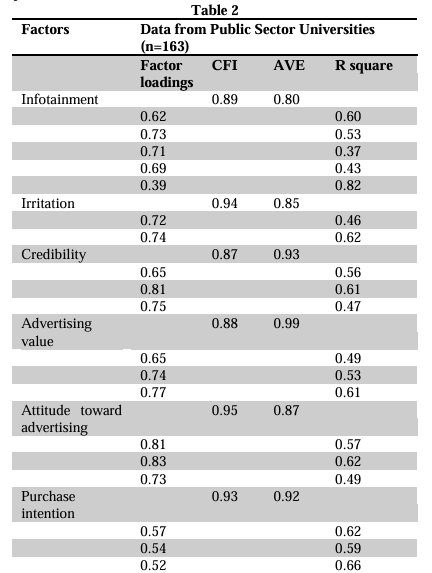
Table 2 shows results of CFA. CFA is conducted before the formal comparison and it describes how well the nineteen
items calculate all constructs. Four analyses were accomplished to access the measurement model.The overall fit of the model is acceptable. The chi square statistics (2.1<3) is significant in the sample (p<0.01) corresponds to a satisfactory fit [24]The goodness of fit (GFI) estimates are 0.92 respectively, comparative fit index (CFI) estimates are 0.93 provides a good fit to data. Secondly, uni-dimensionality is accessed before examining the validity and reliability, comparative fit index (CFI) is conducted for each of the variables on measurement model. The CFI of every construct is between 0.87 to 0.95 for public sector universities and 0.81 to 0.97 for private sector universities shows good fit, thus signifies evidence of uni-dimensionality [25]. Thirdly, to test the construct reliability; squared multiple correlations ) for every measurement item, and average variance extracted for each factor is used in the study. The ) for every item is ranges between 0.37 to 0.82 for public sector universities and 0.45 to 0.79 for private sector universities, thus shows good reliability. Fourthly, the convergent validity of the
measurement items is obtained by the factor loadings. The standardized factor loadings are between 0.39 to 0.83 for public sector universities and 0.56 to 0.84for private sector universities and are greater than te suggested level of 0.35 and significant, these are good indicators of CFA [25] CFA reveals, all items significantly loaded on individual constructs (p<0.05) [26].
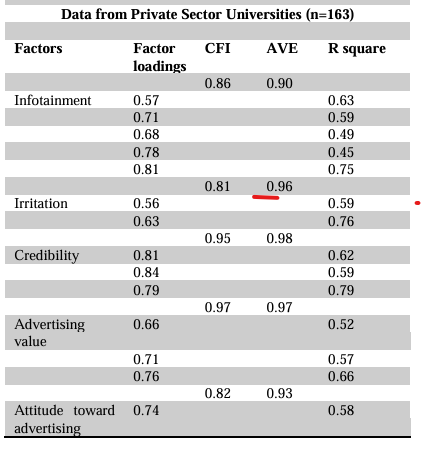
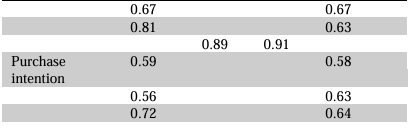
Model fit indices: Chi-square=357.77, df=179, Chi square/df=2.1, CFI=0.93, GFI=0.92
Discriminant validity of the construct is evaluated by calculating the shared average variance extracted between the pair of constructs, its value ranges between 0.80 to 0.99 for public sector universities and 0.91 to 0.98 for private sector universities[27]. Thus, the study exhibits convergent and discriminant validity.
Hypotheses testing:
Research hypotheses are tested on the basis of standardized structural coefficients with SEM. On the basis of the results reported in Table 3, hypotheses are justified as:Hypothesis 1 accounts for the perceived infotainment of mobile advertising
and its positive associations with advertising value. On the basis of analysis, it is identified that hypothesis 1 is supported
in both university sectors t=3.242p<0.01 t=2.221p<0.05. Hypothesis 2 indicates irritation felt as a result of mobile advertising to be negatively associated with advertising value. It is unsupported as relation is insignificant in both universities t=-2.011p>0.01 t=-0.734, p>0.01. Hypothesis 3 accounts for perceived credibility of the customers regarding mobile advertising and its positive relationship with advertising value. It is supported in both groups t=3.242, p<0.05 t=2.432, p<0.05. Hypothesis 4 determines positive relationship of advertising value with attitude towards advertising and according to the results, it is supported t=6.913p<0.01 t=6.754p<0.01.
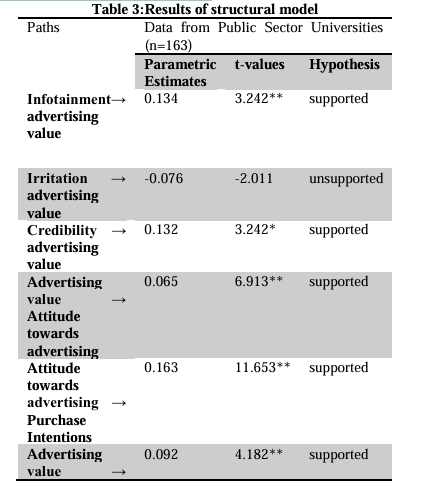
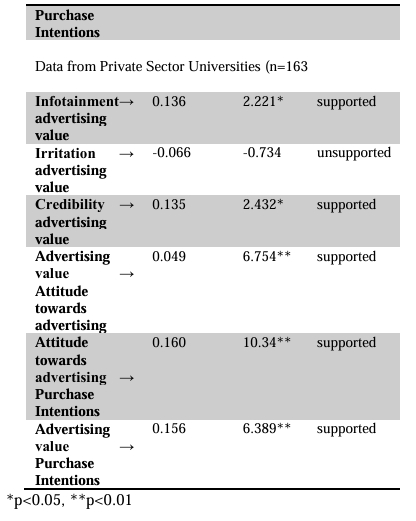
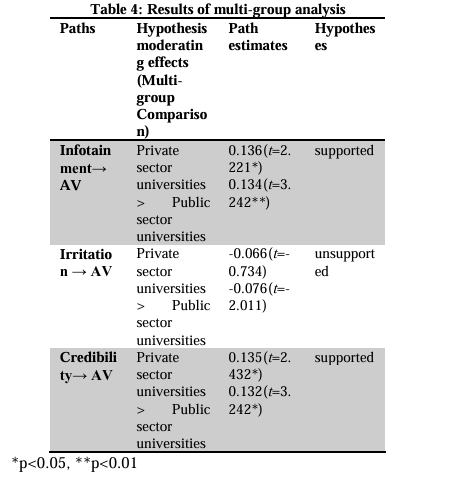
Hypothesis 5 accounts for positive relationship of attitude towards advertising with purchase intentions and results indicate that it is significantly supported t=11.653, p<0.01 t=10.34p<0.01. Hypothesis 6 accounts for positive relationship of advertising value with purchase intention and result indicate that it is significantly supported t=4.182**p<0.01 t=6.389**p<0.01. Besides this, the fit indices of structural model are significant. Model fit indices: Chi-square=389.53, df=197, Chi square/df=2.3, CFI=0.95, GFI=0.93. Multi-group analysis: The multi group comparison of the structural model is applied. The results in Table 4 showed significant differences among the three path coefficients between the two sectors.
Hypothesis 7a accounts for the effect of infotainment on advertising value is greater for private sector universities than
for public sector universities. Infotainment has a greater impact on advertising value in public sector universities than
for private sector universities 0.134(t=3.242**), 0.136(t=2.221*), hence rejects hypothesis 7a.Hypothesis 7b accounts for the effect of irritation on advertising value is greater for private sector universities than public sector universities. Irritation has an insignificant impact in both sector universities -0.076(t=-2.011), -0.066(t=-0.734), thus rejects hypothesis7b.Hypothesis 7c accounts for the effect of credibility on advertising value is greater for the private sector universities than in public sector universities.
Credibility has greater impact on advertising value in public sector universities than for private sector universities 0.132(t=3.242*), 0.135(t=2.432*), therefore rejects the hypothesis 7c.
Discussion & Conclusion
The current study is conducted to understand the antecedents which affect the advertising value, attitude towards advertising and purchase intentions in both sector universities. The significant relationship is identified between credibility, infotainment and the observed advertising value in both sector universities. Moreover, it was also identified that there is a positive relationship between advertising value and attitude towards advertising. Advertising value is identified to be the major contributing factor for determining the overall behavioral attitude and customers purchase intentions. [14] explained that it is obvious to say that advertising affects the behavioral responses of the customers. It is necessary to make marketing messages attention grabbing and entertaining as it is an important factor in creating an emotional link. Mobile advertising sometimes creates voracity and anxiety in society. Previous researches have shown that irritation has negative impact on the value of advertising. The analysis of the results reveals the negative consequences of irritation on the value of advertising and customer purchase intentions. In both sector universities, impact of irritation is insignificant [11]. The analysis reveals that the advertising value has positively affected the behavioral intentions of consumer in both sectors.
Implications of differences of results among universities Another core purpose of the study was to be aware of the cross university differences in consumer’s perception of mobile advertising and its impact on customers’ purchase intentions. The results show some of the major contradictions between public and private sector universities. The impact of infotainment and credibility on the perceived value of advertising is identified to be higher in public sector universities as compared to private sector universities. It shows that both sector universities are less eager to take risks. As discussed earlier, credibility plays an important role in reducing consumer’s doubts about the unwanted mobile messages.Moreover, the effect of irritation is insignificant in both sectors.In public sector universities, it is logical to expect that cross university differences will influence the value of new marketing tool like mobile advertisement. The acceptance of new information technology comes out to be more significantly welcomed. Previous research has also revealed that consumers in public sector universities tend to view advertising as irritating, ambiguous and promoting cupidity. However, the assumption that private sector universities are more sensitive about being addressed by mobile advertisements was not supported. These judgments leave us with the feeling that public sector universities, because of being addressed by mobile advertising for a number of years, are easily annoyed by them and consider them with having just as little credibility as private sector universities do. Marketing managers therefore should develop such strategies so that the advertising’s appeal increases in both sector universities.With such divergence, the marketers need to be vigilant when they employ a centralized mobile marketing approach. They could apply the precursory insights from this study to adjust their marketing approaches to different sectors.
Theoretical and Future Implications
The study contributes to advertising literature in a couple of ways. First, it expands the conceptualization and empirical evidence regarding infotainment, irritation and credibility in the context of purchase intention. Secondly, it enhances our understanding how perception of consumers play imperative role in shaping attitudes and intentions for purchase. The
study provides imperative managerial implications for Telecom Sector who attempts to send messages on mobile phones. The credibility of source plays crucial role in shaping attitude. Therefore, they should make such advertising messages that can create influential impact on customers.In future, new variables such as: brand exposure, humorous advertising and brand awareness could be introduced to check the impact on purchase intention.
References
Mohamed Yunos, H., Jerry Zeyu Gao, & Simon Shim. . Wireless Advertising’s Challenges and Opportunities,Computer, 36 (5), 30-37(2003)
Tirmizi, Muhammad Ali, Kashif Ur Rehman, &M. Iqbal Saif.. An empirical study of consumer impulse buying behavior in local markets,European Journal of Scientific Research,28, 522-532(2009).
Lee, Su-Fang, Yuan-Cheng Tsai, & Wen-Jang Jih. An Empirical Examination of Customer Perceptions of Mobile Advertising, Information Resource Management Journal, 19(4), 21-38(2006).
Liu, Chia-Ling Eunice, Rudolf R. Sinkovics, Noemi Pezderka, & Parissa Haghirian. (2012). Determinants of Consumer Perceptions towards Mobile Advertising – A Comparison between Japan and Austria,Journal of Interactive Marketing, 26, 21-32(2012).
Niazi, Ghulam Shabbir Khan, Javaria Siddiqui, Burhan Ali Shah, & Ahmed Imran Hunjra.. Effective Advertising and its Influence on Consumer Buying Behavior, Information Management & Business Review,4 (3), 114-119(2012).
Varnali, Kaan, Cengiz Yilmaz, & Aysegul Toker. (2012). Predictors of attitudinal and behavioral outcomes in mobile experiment, Electronic advertising: Commerce A field Research & Applications, 11, 570-581.
Yang, Byunghwa, Youngchan Kim, & Changjo Yoo.. The integrated mobile advertising model: The effects of technology and emotion based evaluation,Journal of Business Research, 66, 1345-1352(2013).
Ayanwale, Adeolu B., Taiwo Alimi, & Matthew A. Ayanbimipe.. The influence of advertising on Consumer Brand Preference. Journal of Social Sciences,10 (1), 9 16(2005).
Kolsaker, Ailsa, & Nikolaos Drakatos. (2009). Mobile Advertising: The influence of emotional attachment to mobile devices on consumer receptiveness,Journal of Marketing Communications, 15 (4), 267-280.
Koo, Wanmo, Dee K. Knight, Kiseol Yang, &Zheng Xiang. (2012). Generation Y Consumers’ Value Perceptions towards Apparal Mobile advertising: Functions of Modality and Culture,International Journal of Marketing Studies, 4 (2), 56-66.
Watson, Catherine, Jeff McCarthy, & Jennifer Rowley. Consumer attitudes towards mobile marketing in the smart phone era,International Journal of Information Management,33, 840-849(2013)..
Bruner, Gordon C, & Anand Kumar.Attitude towards Location based advertising. Journal of Interactive Advertising, 7 (2), 3-15(2007).
McCole, Patrick, Elaine Ramsey, &John Williams.. Trust considerations on attitude towards online purchasing: The moderating effect of privacy and security concerns,Journal of Business Research,63, 1018-1024(2010).
Hyun, Sunghyup Sean, Wansoo Kim, & Myong Jae Lee.The impact of advertising on patrons’ emotional responses, perceived value and behavioral intentions in the chain restaurant industry: The moderating role of advertising induced arousal,International Journal of Hospitality Management, 30, 689-700(2011).
Pyun, Do Young, & Jeffrey D. James. . Attitude towards advertising through sport: A theoretical framework,Sport Management Review,14, 33-41(2011).
Lee, Jumin, Do-Hyung Park, & Ingoo Han. . The different effects of online consumer reviews on consumers’ purchase intentions depending on trust in online shopping malls,Internet Research, 21 (2), 187 206(2011).
Chen, Kaochun. (2008). A Study of the relationship between UK customers’ purchase intention and store brand food products, Nottingham: The University of Nottingham.
Ducoffe, Robert, H.. How Consumers Assess the Value of Advertising,Journal of Current Issues & Research in Advertising, 17(1), 1-18(1995).
MacKenzie, Scott B., & Richard J. Lutz.. An Empirical Examination of the Structural Antecedents of Attitude toward the Ad in an Advertising Pretesting
Context,Journal of Marketing,53 (2), 48-65(1989).
Alwitt, Linda F, & Paul R. Prabhaker.. Identifying who Dislikes Television Advertising: Not by Demographics Alone, Journal of Advertising Research, 34(6), 17 29(1994).
Grewal, Dhruv, R. Krishnan, Julie Baker, & Norm Borin. The effect of store name, brand name, and price discount on consumers’ evaluations and purchase intention,Journal of Retailing, 74(3), 331-352(1998).
Zeithaml, Valarie A.Consumer perceptions of price, quality and value: a means-end model and synthesis of evidence,Journal of Marketing, 52(3), 48-62(1988).
Richardson, Paul S., Arun K. Jain, & Alan Dick. . Household store brand proneness: a framework,Journal of Retailing, 72(2), 159-185 (1996).
Hair, Joseph F., William C. Black, Barrie J. Babin, & Rolph E. Anderson (2010). Multivariate Data Analysis-a Global Perspective. 7th ed. Upper Saddle River, NJ: Pearson(2010).
Hair, Joseph F., Rolph E. Anderson, & Ronald L. Tatham. Multivariate data analysis with readings,Prentice-Hall International, Englewood cliffs, NJ(1998).
Anderson, James C., & David W. Gerbing. Structural equation modeling in practice: A review and recommended two stage approach,Psychological Bulletin, 27 (1), 5-24(1988).
Fornell, Claes, & David F. Larcker. Evaluating structural equation models with unobservable variables and measurement error, Journal of Marketing Research, 18, 39-50(1981).