
Impact of Dimensions of Corporate Social Responsibilities on purchase intention with mediating role of customer satisfaction, commitment and trust
Farhina Hameed 1, Dr. Abdul Qayyum 2, Younus Awan 3
Farhina Hameed, Dr. Abdul Qayyum & Younus Awan. (2018). Impact of Dimensions of Corporate Social Responsibility on Purchase Intention with Mediating Role of Customer Satisfaction, Commitment and Trust, Pakistan Business Review, 20(1), 13-30.
Abstract
Corporate Social Responsibility (CSR) has been an important matter for companies; however, concerns about CSR issues are also intensified. Despite the prominence of CSR, research is yet to investigate how CSR practices influence customers purchase intentions. The study aims to investigate the CSR effect on purchase intention. It took a step ahead to operationalize CSR into dimensions (social CSR, environmental CSR, and legal CSR) and evaluate each dimension to measure the impact on purchase intention. Secondly, the mediating effect of satisfaction, commitment and trust is examined. Data is collected from cellular users of the Telecom sector of Pakistan; convenience sampling technique is adopted with sample size of 327 individuals. EFA and CFA are conducted to evaluate factors whereas SEM is executed to test hypotheses. The findings showed there significant relation ship exists between CSR dimensions and purchase intention. Moreover, partial mediation exists between CSR dimensions and purchase intention. Result encourages mangers of the Telecom sector to keep investing on CSR activities. Firstly, it examined the dimensions of CSR which is previously taken as a one construct. Secondly, the effect of each dimension on purchase intention is evaluated. Future study can examine the impact of dimensions of CSR in other context such as: FMCG, mobile industry, hospitality sector, oil and gas, and chemical sector etc. The proposed hypotheses can also be tested in developed economies by investigating the significance of social, ethical and legal assumptions in the context of CSR.
Keywords: CSR, Commitment, Environmental CSR, Legal CSR, Purchase Intention, Social CSR
Introduction
The concern regarding Corporate Social Responsibility (CSR) is escalating with each single day and holds strategic implications for businesses. The concept proposed by an American scholar Sheldon in (1924), but initial definition, given by Bowen in (1953), stated that “businessman are obligated to develop policies, make decisions or take certain actions, according to socially desirable goals and values.” It is defined as “policies and practices of corporations that reflects business responsibilities for societal good” (Matten & Moon, 2008). There are many companies around the globe which are practicing CSR and Toms Shoes is one of them. It is for Profit Company in California founded in 2006 but their business model is based on CSR. When they sell shoes, a pair of new shoes is given to aa needy child and when they sell eye wear, a part of profit is used to save the eyesight of people. Thus, the company is not only making profits but it is also concerned about the welll being of the needy and the poor 4. The trend of CSR is rising in Pakistan and the perception regarding CSR
activities is changing (Chaudhary et al., 2016). CSR is broader in nature that incorporates different dimensions. Previously, the combined effect of CSR was measured while having multiple variables but the actual dimensions of CSR were unclear. The study aims to investigate CSR effect on purchase intention. The study took step ahead and operationalizes CSR into dimensions and evaluates each dimension (social CSR, environmental CSR, and legal CSR). The following are the objectives of the study:
• To measure the direct effect of the dimensions of CSR on purchase intention
• To examine the effect of the dimensions of CSR on satisfaction, commitment and trust
• To find the effect of satisfaction, commitment and trust on purchase intention
• To measure the mediating role of satisfaction, commitment and trust in relationship between CSR and purchase intention.
Literature Review
Over the past few decades, CSR has become the integral part of the overall strategy of the organizations. CSR symbolizes activities and initiatives of different organizations with significant social, legal and environmental impact (Du et al., 2007). In competitive environment, managers are facing the pressures to balance the value of shareholders with the welfare of the society (Hull & Rothenberg, 2008). Lii and Lee (2012) investigated the three corporate social responsibility aspects: sponsorship, philanthropic and cause related marketing and these initiatives have significant impact on the attitude of customers which ultimately affect purchase intentions. On the contrary to positive effect, negative publicity affects the purchase intention of customers during product harm crisis (Linet al., 2011). CSR is a broad area of inquiry, in general it addresses the relationship between the firm and society and to what extent the firm is fulfilling its responsibilities towards its society (Carrol, 1979). Still, the precise definition or meaning of CSR needs to be clear. Deng and Jiang (2011) explored the meaning of CSR in consumer’s mind, and found it as a multi-dimensional structure and is divided into various responsibilities such as: employee responsibility, social, consumer, economic and legal responsibilities. Among all of them, consumer’s value, consumer responsibility and others are not https://en.wikipedia.org/wiki/Toms_Shoes#Focuses_for_corporate_responsibility valued comparatively. The growing interest in CSR is apparent in companies because while applying CSR practices they expect benefits out of that. There are numerous studies on CSR that may have effect on consumer behavior, brand loyalty, purchase intention and brand equity. CSR is broader in nature that incorporates different dimensions. Previously, the combined effect of CSR is measured
while having multiple variables but the actual dimensions of CSR are unclear. Previous empirical researches operationalized CSR as a one-dimensional measure that combined these activities. A number of scholars recommended that CSR comprised of numerous dimensions, and each of which is characterized by a collection of different voluntary activities (Clarkson, 1995; Godfrey & Hatch, 2007).
Previously, studies focused on inadequate facets of CSR without inquiring customer’s interest in this notion. A number of scholars recommended that CSR comprised of numerous dimensions, and each of which is characterized by a collection of different voluntary activities (Clarkson, 1995). There are various definitions of CSR but Carrol (1979) divided CSR into four dimensions for the first time: economic, legal, social and environmental. All these activities must be carried out by
the organizations but previous studies incorporated CSR as a whole (Hwang et al., 2016; Perez & Bosque, 2016). According to Carrol, legal and economic responsibility is socially necessary but with the passage of time, the nature of responsibility changes depending upon the industry and strategies. CSR as a multidimensional concept not only affects the purchase intention of customers but also the firm performance (Inoue & Lee, 2011). It is an unresolved paradox, the evaluation of CSR is a complex phenomena and has played a crucial role in describing consumptions decisions differently in a different contexts (Oberseder et al., 2011) and a rising concern in Pakistan (Chaudhary et al. 2016). However, the present study is an endeavor to expose the dimensions of CSR which includes social, environmental and legal dimension in Telecom sector of Pakistan (Chaudhary et al., 2016; Hsu, 2012; Hur et al., 2013) and their effect on satisfaction, commitment (Lin et al., 2011; Jean et al., 2016) and trust (Lin et al., 2011; Hansen et al., 2011; Park et al., 2016) which ultimately leads towards purchase
intention. However, it was limited to guide the researcher about the process and measuring the dimensions of CSR. The model is developed on the basis of aforementioned theories, literature and model developed by Carrol (1979). To measure the effect of dimensions of CSR on purchase intention with mediating role of customer satisfaction, commitment and trust was the objective of the study. Though there are various companies in Asia and specifically in Pakistan which are practicing CSR but the purpose of the study is to measure the effect of each dimension of CSR on the purchase intention in
Telecom sector of Pakistan.
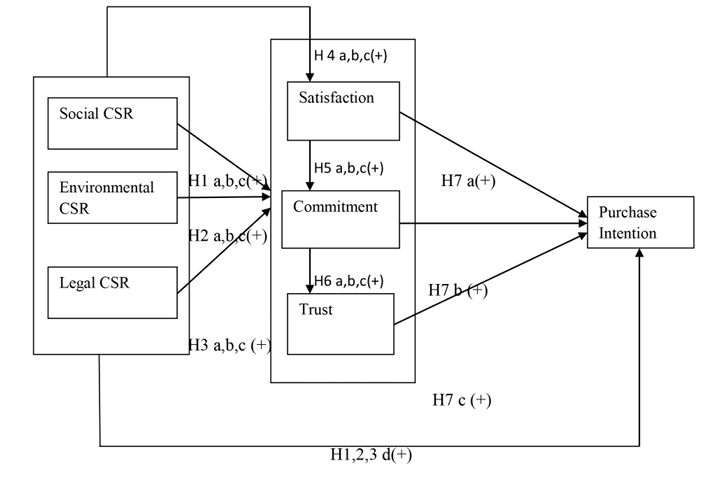
The concept of purchase intention is entrenched in behavioral and psychological studies, consequently; Theory of Reasoned Action (TRA) works in identifying and understanding association between purchase intention and CSR. It explains the “behavior of a consumer is exclusively dependent on personal agency and that control over behavior is comparatively insignificant”. The TRApropounded by Ajzen and Fishbein (1975) paved the path for the TPB by Ajzen (1991). Purchasing
behavior has been examined via the use of this theory towards environmentally sustainable products. According to the TRA, the intention of undertaking/not-undertaking the behavior is the direct predecessor to the behavior. The relationship of purchase intention with other variables of interest depends upon the TRA and TPB. The growing interest of CSR is apparent in companies because while applying CSR practices they expect benefits. Three dimensions are taken out that includes social, environmental and legal dimensions of CSR to check their impact on the purchase intention in the presence
of satisfaction, commitment and trust. H 1, 2, 3 a, b, c, d: There is a positive relationship between social CSR, environmental CSR and legal CSR with satisfaction, commitment, trust and purchase intention.
A satisfaction is an evaluative consequence of CSR and influences the behavioral outcomes through multiple paths. When the customer realize that a particular organization is socially responsible and engage in CSR activities, they build positive perception and develop a sense of association (Luo & Bhattacharya, 2006). Walsh and Bartikowwski (2013) investigated satisfaction as a mediator in the association among CSR and corporate ability and their impact on behavioral outcomes such as loyalty intention, purchase intentions and CSR on post purchase intention. Former studies explained the direct effect of satisfaction of customers on brand loyalty (Hameed, F. 2013). On the basis of stakeholder management theory, the paper explored multidimensional perception of CSR and its effect on satisfaction (Perez & Bosque, 2016).
H4 a, b, c: Satisfaction mediates the relationship between social CSR, environmental CSR, legal CSR and purchase intention.
CSR activities of the organizations affect perceived morality which successively predicts employee commitment (Ellemers et al., 2011; Jayabalan et al., 2016). Lim and Tsutsui (2012) uttered about global social responsibility framework and the adoption of CSR activities has significant impact on the commitment of customers. But the impact of CSR activities on customer relationship is unclear. Herm (2013) investigated the role of commitment, and hypothesizes trust as a vital precursor of commitment; high brand commitment leads towards high trust on the brand.
H5 a, b, c: Commitment mediates the relationship between social CSR, environmental CSR, legal CSR and purchase intention. CSR directly affects the purchase intention of customers (Hwang et al., 2016) by having brand trust as a mediator (Herbst et al., 2013). Trust is generally rooted in social identity theory because identification exerts influence on purchase intention (Ellemers et al., 1999). Abdeen et al. (2016) investigated the relationship between CSR and customers purchasing behavior. Nowadays, CSR is gaining momentum amongst researchers and it’s an evolving topic. In linking the evidence, it
is seen that CSR’s effect is mediated by role of trust. It is evident in the study (Lee et al., 2013) that CSR has a positive impact on the trust of an individual eventually leads towards satisfaction. Choi and La (2013) provided theoretical implications for the association between CSR and customer satisfaction.
H6 a, b, c: Trust mediates the relationship between social CSR, environmental CSR, legal CSR and purchase intention.
H7 a, b, c: There is a positive relationship between satisfaction, commitment, trust and purchase intention.
Method
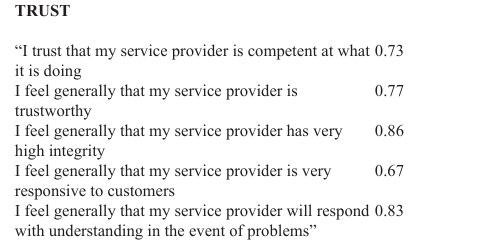
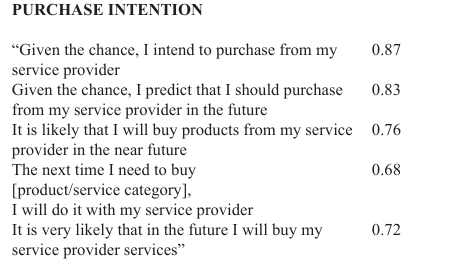
The instrument was adapted and the questions regarding demographics and variables of interest were split into two parts. Ten items of social CSR and environmental CSR each and six of legal CSR was adapted from Du et al. (2007), Curras-Perez et al. (2009), Hanzaee and Rahpeima, (2013), Vazquez et al. (2011) and Kim et al. (2010). Five items of satisfaction, commitment, trust and purchase intention each were adapted from Cronin et al. (2000), Kimpakorn and Tocquer (2009), Sirdeshmukh et al. (2002) and Pavlou (2003). There were a total 46 items and 5 points Likert scale was used which had options from strongly disagree to strongly agree. Faculty of various universities of the twin cities of Rawalpindi & Islamabad) was taken as a population. Out of 19 universities 03 universities were selected which includes: Quaid-e-Azam University, Federal Urdu University, and Virtual University of Pakistan. Convenience sampling technique was used to collect data and faculty members were opted because they are more knowledgeable regarding CSR activities and the dimensions of CSR includes social, environmental and legal CSR and they were needed to think before filling the questionnaire weather the telecom service provider they were using was practicing CSR and specifically which dimension of CSR. The telecom sector was taken as a whole to evaluate the concept of CSR because it’s a growing phenomenon in Pakistan and they are practicing CSR activities. It includes all five telecom companies providing its facilities in Pakistan that include: Ufone, Warid, Zong, Mobilink, and Telenor. Operators of Telecom sector are indulged in CSR activities and the following activities are observed: Flood relief, Citizen Foundation, Tabeer transport service for women, SOS Iftar, Training in schools and Breast cancer awareness sessions, donating cash to education and health sector and they are donating money on regular basis. They are also donating to environmental pollution prevention causes and are doing cause-related marketing via SMS and
recorded phone calls. They are donating money in order to rescue lives due to certain disasters like earthquake and flood etc. Above and beyond, Telecom sector is playing a positive role in improving the health care facilities and ensures health care facilities primarily to affluent and poor social backgrounds. A total of 400 questionnaires were distributed among faculty members and 327 were received. Thus, the response rate of the study was 81%. To set up the content validity, items were presented to some experts; they read the items carefully to find triviality, ambiguity and vague statements.
Results
The descriptive analysis shows the number of male respondents was more than female respondents. Maximum of the data was collected from 26-30 years age group and who had higher education. Moreover, a greater part of the respondents lies in the income band of 40,001-60,000.
Exploratory Factor Analysis (EFA)
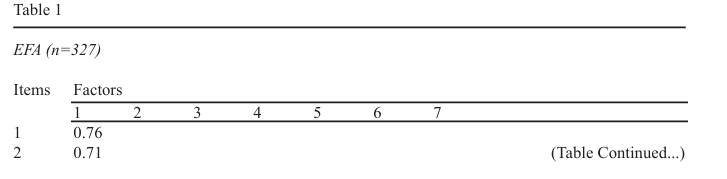
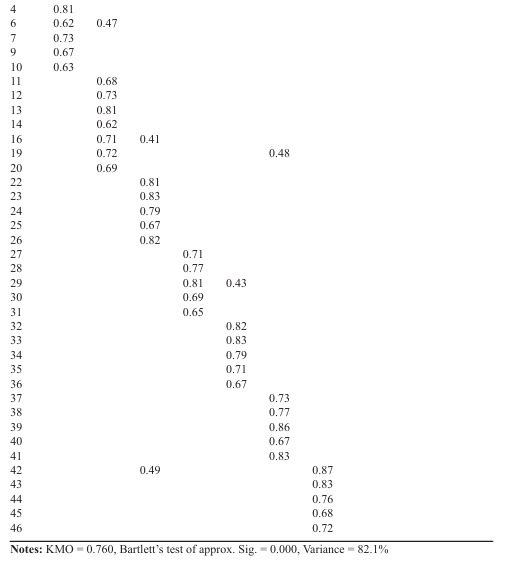
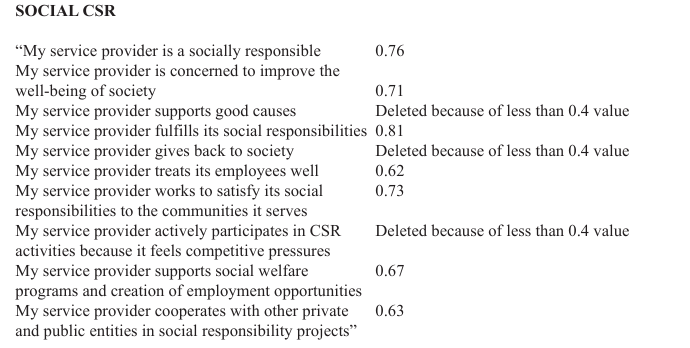
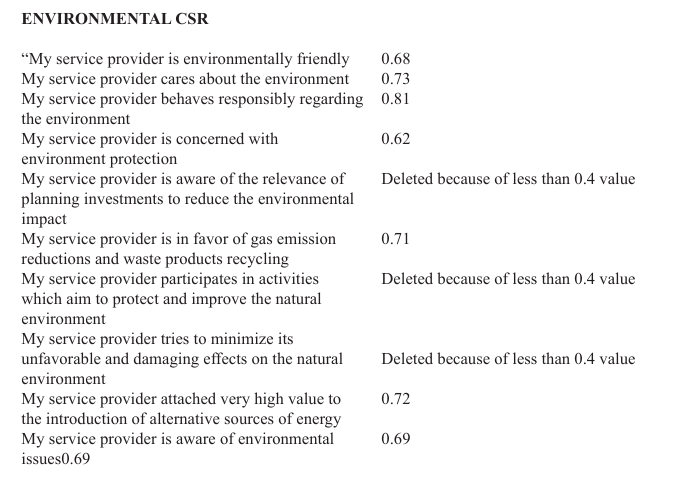
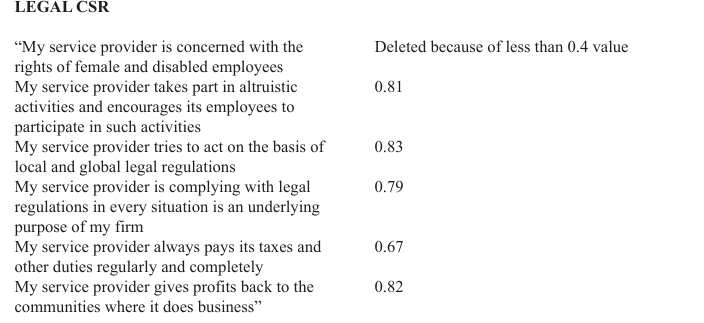
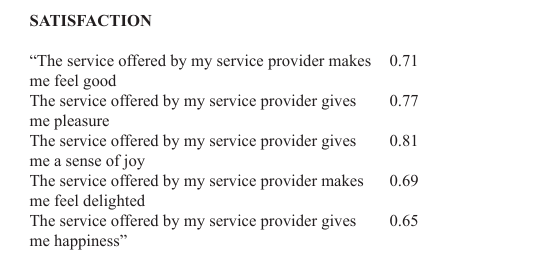
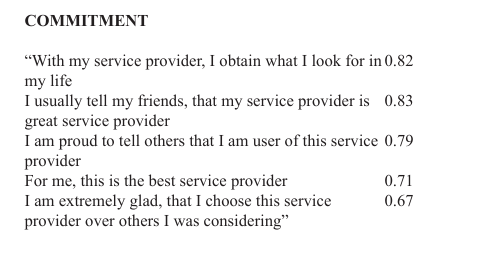
EFA is accomplished via SPSS-21. KMO and Bartlett’s test measures sampling adequacy and value is 0.760 (Kaiser, 1974). The Bartlett’s test value is significant at p = 0.000 and less than 0.05 (Bartlett, 1954), therefore, factor analysis is suitable. Entirely 7 items were removed from the study, 3 from social CSR and environmental CSR each and 1 from legal CSR construct and factor loadings indicated 82.1% variance. The items with factor loading less than 0.40 were removed from the analysis. Since, seven factors were requested, based on the fact that the items were designed to index seven constructs and results elucidate that the study retained 39 items for further analysis.
Confirmatory Factor Analysis (CFA)
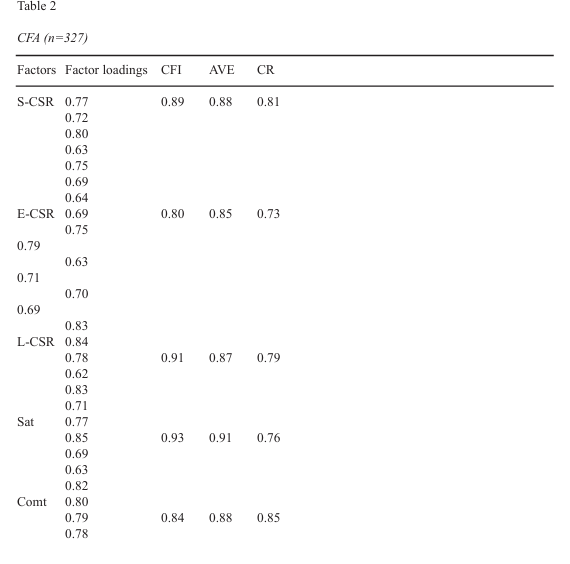
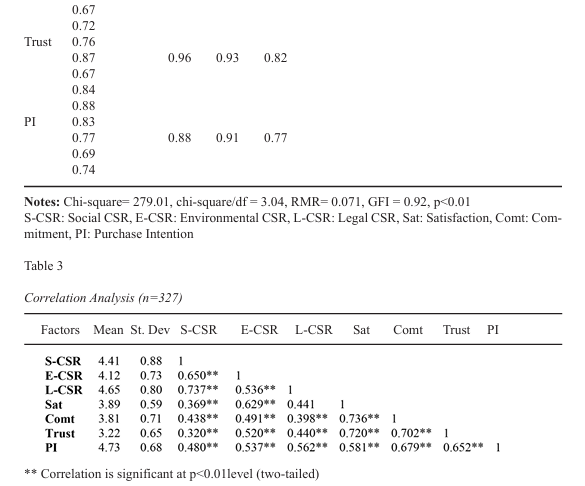
Before testing the hypotheses by means of structural model, the measurement model is evaluated called CFA via AMOS-20. It describes how well the 39 items explain 7 constructs. For CFA, Kline (2005) proposed a least fit indexes set that reflect model fit. Root mean square residual (RMR) =0.071(<0.05 or 0.08: Ryu et al., 2003) comparative fit index (CFI) is between 0.80 to 0.96 signifies evidence of uni-dimensionality (Hair et al., 1998), goodness of fit (GFI) = 0.92(>0.90; >0.8: Ryu et al., 2003) chi-square = chi-square/df= 3.040, supporting overall model fit. Composite reliability of all measures surpasses 0.6, representing a positive level of internal constancy reliability. Convergent validity take place when: all factor loadings are significantly more than thresh old 0.50 (Fornell and Larcker, 1981). The average variance extracted (AVE) of respective constructs in their items are higher than the variance that is unexplained. The factor composite reliability is equal to or greater than 0.60, thus aforementioned values show strong convergent validity (Bagozzi & Yi, 1988; Fornell & Larcker, 1981).
Construct discriminant validity was estimated via shared average variance extracted among the constructs pair, its value ranges between 0.85 to 0.93 (Fornell & Larcker, 1981). It is attained when the estimated average variance extracted higher than the squared correlation estimates, average variance extracted (AVE) of every variable are more than the squared correlations of any pairs of variables, which supports the discriminant validity of all measures in this study (Awan & Hameed, 2014; Hameed, Rehman & Awan, 2016; Hameed & Awan, 2017). On the base of aforesaid outcome, it is declared that study confirmed convergent validity and discriminant validity. As the instrument is adapted thus, normality of data is tested via Skewness and Kurtosis test and value of all variables lie between +1 and -1.
Structural Equation Modeling (SEM)
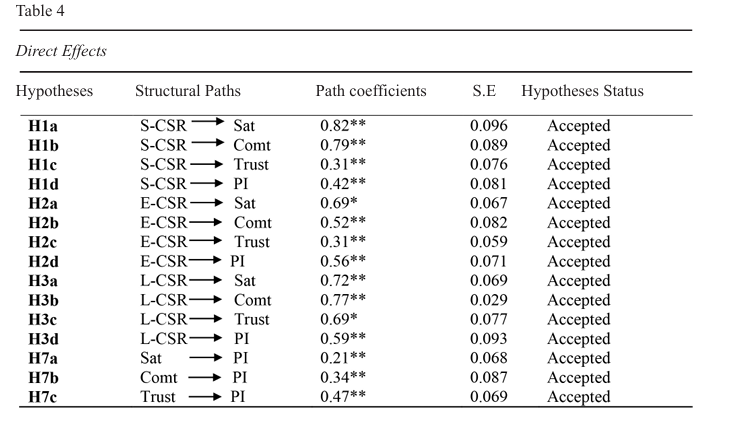
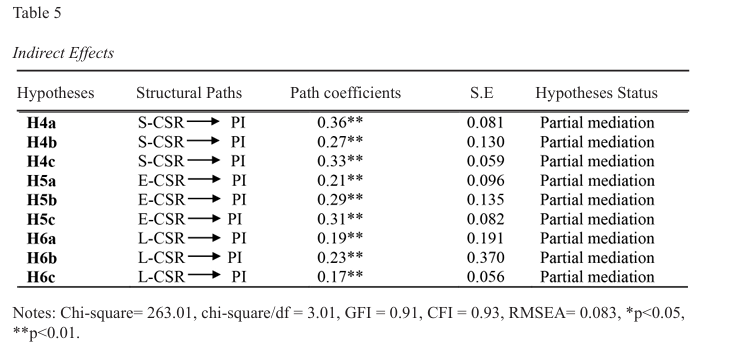
The structural model is developed to test the hypotheses. The path estimates of H1a, b, c, d showed significant direct relationship between variables (0.82**, 0.79**, 0.31**, 0.42** p<0.01) thus, supports H1a, b, c, d. The path estimates of H2 a, b, c, d showed significant relationship between the variables (0.69* (p<0.05) 0.52**, 0.31**, 0.56** p<0.01) thus supports H2 a, b, c, d. The path estimates of H3 a, b, c, d showed positive significant relationship (0.72**, 0.77** (p<0.01), 0.69* (p<0.05), 0.59** (p<0.01) therefore accepts H3 a, b, c, d. H4 a, b, c the path leading from social, environmental and legal CSR to purchase intention, there is one direct effect and one indirect effect. The estimated direct effect of social, environmental and legal CSR on satisfaction (0.82**, 0.69*, 0.72**) and satisfaction on purchase intention is significant (0.21**). Correspondingly, indirect impact of social CSR, environmental CSR and legal CSR on purchase intention via satisfaction is also significant (0.36**, 0.21**, 0.19**). Since the outcome meet the necessary condition of validating mediating impact of satisfaction (Plewa et al., 2014; Hsu, 2012; Luo & Bhattacharya, 2006). The beta value of direct impact is greater as compared to indirect impact thus shows partial mediation exist therefore accepts H4 a, b, c. Similarly, for H5 a, b, c the estimated direct effect of social, environmental and legal CSR on commitment (0.79**, 0.52**, 0.77**) and commitment on purchase intention is
significant (0.34**). Correspondingly, indirect impact via commitment is also significant (0.27**, 0.29**, 0.23**). The beta value of direct impact is greater as compared to indirect impact thus shows partial mediation exist therefore accepts H5a, b, c. Correspondingly, H6 a, b, c the estimated direct effect on trust (0.31**, 0.31**, 0.69*) and trust on purchase intention is significant (0.47**). Correspondingly, indirect impact on purchase intention via trust is also significant (0.33**, 0.31**, 0.17**).
The beta value of direct impact is greater as compared to indirect impact thus shows partial mediation exist therefore accepts H6 a, b, c. H7 a, b, c demonstrate positive relationship of satisfaction, commitment and trust with purchase intention, hence path estimates showed positive relationship with each other (0.21**, 0.34**, 0.47**, p<0.01) consequently supports H7 a, b, c.
Discussion
CSR has been an important matter for businesses; it can help decision makers to make intelligent decisions for businesses and their stakeholders. The findings of the study illustrated that as the study operationalized CSR into three dimensions thus CSR dimensions have positive impact on purchase intention. CSR of the firm influences the behavior of the consumers which ultimately builds the perceptions or intentions. Consumers consider social initiatives as information cue and proactive initiatives by the company makes customers beliefs, attitudes and perceptions positive (Becker et al., 2006). The growing body of literature showed the positive effect of CSR on customer behavior and purchase intentions (Grimmer & Bingham, 2013). CSR is an unresolved paradox and its evaluation is a complex phenomena and played crucial role in describing consumptions decisions (Oberseder et al., 2011). Moreover, the results of the study confirmed significant effect of CSR dimensions on satisfaction. For the organization that practices CSR, customers build positive perception and develop a sense of association with that particular firm (Luo & Bhattacharya, 2006). CSR is considered as a source of satisfaction for employees as well as for customers. Studies from previous literature also supported the mediating impact of satisfaction (Hsu, 2012). In addition to this, the findings of the study confirmed the significant impact of CSR dimensions on commitment and the impact of CSR strengthens the customer relationships (Herm, 2013). The results confirmed partial mediation of commitment in association between CSR dimensions and purchase intention. Satisfaction increases the level of trust in individuals and enhances commitment towards brand that leads towards purchase intention (Wu et al., 2010). Consequently, the findings of the study supported the direct effect of CSR dimensions on the trust of an individual (Lee et al., 2013). Furthermore, trust is shown as a partial mediator in relationship between CSR dimensions and purchase intention. CSR directly affects purchase intention of customers by having brand trust as a mediator (Herbst et al., 2013). Previous studies also supported trust as a mediator in explaining corporate social responsibility (Hansen et al., 2011; Choi & La, 2013). It is recognized as a pre requisite for building customer relationships and ultimately purchases intentions (Lin et al., 2011).
Implications
Since, the study has objective to evaluate the effect of CSR dimensions on purchase intentions, hence, firstly, it demonstrates the importance of CSR dimensions and that there is an impetus on the firms to build awareness regarding CSR activities because study found the imperative role of CSR dimensions. Consumers generally do not seek information regarding CSR activities so, managers need to communicate and build awareness among customers. Secondly, it encourages mangers of Telecom sector to keep investing on CSR activities. Customers are inclined towards companies
who practice CSR; it acts as a protection and protects companies from undesirable actions (Fombrunet al., 2000). Thirdly, CSR activities make consumers satisfied and committed to the brand because consumers favor those companies which are socially responsible. Fourthly, results can be used by corporate affairs, directors and policy makers in making policies that can help in creating wealth, maximizing the company’s profits, and increasing their market share. Thus, by practicing CSR activities companies can make customers satisfied and committed which will help them raises the level of trust of their brand/company which in turn increases the purchase intention of the customers. Theoretically, the present study made a number of contributions. Firstly, it examined the effect of dimensions of CSR which were previously taken as a one construct. Secondly, the effect of each dimension on purchase intention is evaluated. Thirdly, the role of satisfaction, commitment and
trust as a mediator with each dimension of CSR is examined. There are a number of limitations, as people lack awareness about CSR activities and lack of resources to accomplish the task. Future study can examine the impact of the dimensions of CSR in other context such as: FMCG, mobile industry, hospitality sector, oil and gas, and chemical sector etc and the proposed hypotheses can also be tested in developed economies by investigating the significance of social, ethical and legal assumptions in the context of corporate social responsibility.
References
Abdeen, A., Rajah, E., & Gaur, S. S. (2016). Consumers’ beliefs about firm’s CSR initiatives and their purchase behaviour. Marketing Intelligence & Planning, 34(1), 2-18.
Ajzen, I. (1991). The theory of planned behavior. Organizational behavior and human decision processes, 50, 179-211.
Ajzen, I., & Fishbein, M. (1975). Attitude-behavior relations: a theoretical analysis and review of empirical research. Psychological Bulletin, 84, 888-918.
Awan, M. Y., & Hameed, F. (2014). The effect of demographic, socio-economic and other characteristics on donations. Current Research Journal of Social Sciences, 6(2), 55-76.
Bartlett, M.S. (1954). A note on the multiplying factors for various chi square approximations. J. Roy. Stat. Soc. B, 16, 296-298.
Becker-Olsen, K. L., Cudmore, B. A., & Hill, R. P. (2006). The impact of perceived corporate social responsibility on consumer behavior. Journal of Business Research, 59(1), 46-53. Bowen, H. R. (1953). Social responsibilities of the businessman (No. 3). Harper & Brothers. Carroll, A. B. (1979). A three dimensional model of corporate performance. Academy of Manage
ment Review, 4, 497-505.
Chan, K. (1998). Mass communication and pro-environmental behavior: Waste recycling in Hong Kong. Journal of Environmental Management, 52, 317-325.
Chaudary, S., Zahid, Z., Shahid, S., Khan, S. N., & Azar, S. (2016). Customer perception of CSR initiatives: its antecedents and consequences. Social Responsibility Journal, 12(2).
Choi, B., & La, S. (2013). The impact of corporate social responsibility (CSR) and customer trust on the restoration of loyalty after service failure and recovery. Journal of Services Marketing, 27(3), 223-233.
Clarkson, M. E. (1995). A stakeholder framework for analyzing and evaluating corporate social performance. Academy of Management Review, 20(1), 92-117.
Cronin Jr, J. J., Brady, M. K., & Hult, G. T. M. (2000). Assessing the effects of quality, value, and customer satisfaction on consumer behavioral intentions in service environments. Journal of Retailing, 76(2), 193-218.
Curras-Perez, R., Bigne-Alcaniz, E., & Alvarado-Herrera, A. (2009). The role of self-definitional principles in consumer identification with a socially responsible company. Journal of Business Ethics, 8 (4), 547-564.
Deng, D. J., & Jiang, K. (2011). Connotation of corporate social responsibility: A view from consumers. China Soft Science, 10, 0-11.
Du, S., Bhattacharya, C. B., & Sen, S. (2007). Reaping relational rewards from corporate social responsibility: The role of competitive positioning. International Journal of Research in Marketing, 24(3), 224-241.
Ellemers, N., Kingma, N., Burgt, J., & Barreto, M. (2011). Corporate social responsibility as a source of organizational morality, employee commitment and satisfaction, Journal of Organizational Moral Psychology, 1(2), 97-124.
Ellemers, N., P. Kortekaas and J. W. Ouwerkerk: 1999, ‘Self-Categorization, Commitment to the Group, and Group Self-Esteem as Related but Distinct Aspects of Social Identity’, European Journal of Social Psychology, 29(2/3), 371-389.
Fombrun, C. J., Gardberg, N. A., & Barnett, M. L. (2000). Opportunity platforms and safety nets: Corporate citizenship and reputational risk. Business and Society Review, 105(1), 85-106.
Fornell, C. & Larcker, D. (1981). Evaluating structural equation models with unobservable variables and measurement error, Journal of Marketing Research, 18, 39-50.
Godfrey, P. C., & Hatch, N. W. (2007). Researching corporate social responsibility: An agenda for the 21st century. Journal of Business Ethics, 70(1), 87-98.
Grimmer, M., & Bingham, T. (2013). Company environmental performance and consumer purchase intentions. Journal of Business Research, 66(10), 1945-1953.
Hair, J. F., Anderson, R. E., Tatham, R. L. & Black, W. C. (1998). Multivariate data analysis with readings. Prentice-Hall international, Englewood cliffs, NJ.
Hameed, F. (2013). The effect of advertising spending on brand loyalty mediated by store image, perceived quality and customer satisfaction: A Case of Hypermarkets. Asian Journal of Business Management, 5(1).
Hameed, F., Rehman, H. & Awan. Y. (2016). Measuring the determinants of consumer perception regarding mobile advertisement in Pakistan: A comparison between private and public sector universities. Science International, 28(1), 735-741. Hameed, F., & Awan. Y. (2017). Effect of dimensions of advertising on behavioral intentions of customers. Pakistan Business Review, 19(1), 138-156.
Hansen, S. D., Dunford, B. B., Boss, A. D., Boss, R. W., & Angermeier, I. (2011). Corporate social responsibility and the benefits of employee trust: A cross-disciplinary perspective. Journal of Business Ethics, 102(1), 29-45.
Hanzaee, K. H., & Rahpeima, A. (2013). Corporate social responsibility (CSR): A scale development study in Iran. Research Journal of Applied Sciences, Engineering and Technology 6(9), 1513-1522.
Herbst, K. C., Hannah, S. T., & Allan, D. (2013). Advertisement disclaimer speed and corporate social responsibility: Costs to consumer comprehension and effects on brand trust and purchase intention. Journal of Business Ethics, 117(2), 297-311.
Herm, S. (2013). When things go wrong, don’t rely on committed consumers: effects of delayed product launches on brand trust. Journal of Product Innovation Management, 30(1), 70 81.
Hsu, K. T. (2012). The advertising effects of corporate social responsibility on corporate reputation and brand equity: Evidence from the life insurance industry in Taiwan. Journal of Business Ethics, 109(2), 189-201.
Hur, W. M., Kim, H., & Woo, J. (2013). How CSR leads to corporate brand equity: Mediating mechanisms of corporate brand credibility and reputation. Journal of Business Ethics, 1- 12.
Hwang, D. R., Lee, S. H., & Do, H. O. (2016). Convergence generation the corporate research activities on the impact of CSR on purchase: Focusing on the mediating effect of the image and reputation. Journal of Digital Convergence, 14(3), 127-134.
Hull, C. E., & Rothenberg, S. (2008). Firm performance: The interactions of corporate social performance with innovation and industry differentiation. Strategic Management Journal, 29, 781-789.
Inoue, Y., & Lee, S. (2011). Effects of different dimensions of corporate social responsibility on corporate financial performance in tourism-related industries. Tourism Management, 32(4), 790-804.
Jayabalan, J., Appannan, J. S., Low, M. P., & Ming, K. S. (2016). Perception of Employee on the relationship between Internal Corporate Social Responsibility (CSR) and Organizational Affective Commitment. Journal of Progressive Research in Social Sciences, 3(2), 168-175.
Jean, R. J. B., Wang, Z., Zhao, X., & Sinkovics, R. R. (2016). Drivers and customer satisfaction outcomes of CSR in supply chains in different institutional contexts: a comparison between China and Taiwan. International Marketing Review, 33(4).
Kaiser, H. (1974). An index of factorial simplicity. Psychometrika, 39, 31-36.
Kim, H. R., Lee, M., Lee, H. T., & Kim, N. M. (2010). Corporate social responsibility and employee-company identification. Journal of Business Ethics, 95(4), 557-569.
Kimpakorn, N., & Tocquer, G. (2009). Employee’s commitment to brands in the service sector: Luxury hotel chains in Thailand. Journal of Brand Management, 16, 532-544
Kline, R. B. (2005). Principles and practice of structural equation modeling (2nd ed.). New York:The Guilford Press.
Lee, C. K., Song, H. J., Lee, H. M., Lee, S., & Bernhard, B. J. (2013). The impact of CSR on casino employee’s organizational trust, job satisfaction, and customer orientation: An empirical examination of responsible gambling strategies. International Journal of Hospitality Management, 33, 406-415. Lii, Y. S., & Lee, M. (2012). Doing right leads to doing well: When the type of CSR and reputation interact to affect consumer evaluations of the firm. Journal of Business Ethics, 105(1), 69-81.
Lim, A., & Tsutsui, K. (2012). Globalization and commitment in corporate social responsibility cross national analyses of institutional and political economy effects. American Sociological Review, 77(1), 69-98.
Lin, C. P., Chen, S. C., Chiu, C. K., & Lee, W. Y. (2011). Understanding purchase intention during product-harm crises: Moderating effects of perceived corporate ability and corporate social responsibility. Journal of Business Ethics, 102(3), 455-471.
Locke, E. A (1976). The nature and causes of job satisfaction. NY: Springer Verlag.
Luo, X., & Bhattacharya, C. B. (2006). Corporate social responsibility, customer satisfaction, and market value. Journal of Marketing, 70(4), 1-18.
Matten, D., & Moon, J. (2008). Implicit and explicit CSR: A conceptual framework for a comparative understanding of corporate social responsibility. Academy of Management Review, 33(2), 404-424.
Oberseder, M., Schlegelmilch, B. B., & Gruber, V. (2011). Why don’t consumers care about CSR?: A qualitative study exploring the role of CSR In consumption decisions. Journal of Business Ethics, 104(4), 449-460.
Park, G., Kim, W., Oh, J., & Chung, K. (2016). Study on the Structural Relationship among CSR Motivations, CSR Activities, Trust and Loyalty: Focused on Korea Retailing Sector.
Pavlou, P. A. (2003). Consumer acceptance of electronic commerce: integrating trust and risk with the technology acceptance model. International Journal of Electronic Commerce, 7(3), 69-103.
Plewa, C., Conduit, J., Quester, P. G., & Johnson, C. (2014). The impact of corporate volunteering on CSR image: A consumer perspective. Journal of Business Ethics, 1-17.
Ryu, S., Ho, S. H., & Han, I. (2003). Knowledge sharing behavior of physicians in hospitals, Expert Systems with Application, 25, 113-122.
Sheldon, H. A. (1924). U.S. Patent No. 1,508,416. Washington, DC: U.S. Patent and Trademark Office.
Sirdeshmukh, D., Singh, J., & Sabol, B. (2002). Consumer trust, value and loyalty in relational exchanges. Journal of Marketing, 66(1), 15-37.
Vazquez, D. G., Sanchez-Hernandez, M. I., & Martinez-Azua, M. B. C. (2011). Validation of a measurement scale for the relationship between the orientation to corporate social responsibility and other business strategic variables.
Walsh, G., & Bartikowski, B. (2013). Exploring corporate ability and social responsibility as sociations as antecedents of customer satisfaction cross-culturally. Journal of Business Research, 66(8), 989-995.
Wu, J. J., Chen, Y. H., & Chung, Y. S. (2010). Trust factors influencing virtual community members: A study of transaction communities. Journal of Business Research, 63(9), 1025-1032.