
Brand awareness and purchase intention in the age of digital communication: A moderated mediation model of celebrity endorsement and consumer attitude
Farhina Hameed 1
Ishtiaq Ahmed Malik 2
Noor Ul Hadi 3
Muhammad Ali Raza 4
1Faculty of Management Sciences, National University of Modern Languages, Islamabad, PAKISTAN
2Department of Management Sciences, University of Chakwal, Chakwal, PAKISTAN
3College of Business Administration, Prince Mohammad Bin Fahd University, Al-Khobar, SAUDI ARABIA
4Department of Management Sciences, COMSATS University Islamabad, PAKISTAN
Citation: Hameed, F., Malik, I. A, Hadi. N. U., & Raza, M. A. (2023). Brand awareness and purchase intention in the age of
digital communication: A moderated mediation model of celebrity endorsement and consumer attitude. Online Journal of
Communication and Media Technologies, 13(2), e202309. https://doi.org/10.30935/ojcmt/12876
Abstract
The proliferation of technology in today’s world has led consumers to gain insight into brands via digital communication and shape their purchase intentions accordingly. However, brand awareness alone might not be sufficient to enhance consumers’ purchase intentions in the age of digital communication. Therefore, to paint a more comprehensive picture of this relationship, the paper seeks to address how and when does brand awareness lead to purchase intention in
the age of digital communication? Based on the quantitative design, 208 responses conveniently collected were analyzed, and PLS-SEM was employed to examine the hypothesized relationships. The study clarifies empirically the indirect effect of brand awareness, consumer attitude, and purchase intention in the age of digital communication. The study also provides new insights into the moderated-meditation relationship, results indicate that brand awareness in the presence of celebrity endorsement will develop a positive attitude that will positively affect purchase intention. The findings of the study not only contribute to advancing the mediating effect of consumer attitude but also verify the buffering role of celebrity endorsement. In conclusion, companies that use digital communication technologies and take into consideration celebrities who are well-liked by the target market may be able to attract consumers’ attention, shape attitude, and influence them to make a purchase. In the end, both theoretical and practical implications are discussed
Keywords: purchase intention, digital communication, brand awareness, consumer attitude,
celebrity endorsement
Introduction
Purchase intention is a situation when a buyer is likely to acquire a specific product in a specific situation (Venkateswara Rao & Elavarasan, 2022). According to Shah et al. (2012), purchase intention is the propensity of a buyer to purchase a particular good in a particular situation. Purchase intention is a useful instrument for anticipating purchase decisions (Ghosh et al., 2021). Price, perceived quality, and perceived value may have a significant impact on purchase intention. During the purchasing process, buyers are influenced by both internal and external factors (Gogoi, 2013). Owing to its importance, purchase intention has been studied in cross-culture by several scholars and has been linked with various factors such as perceived behavioral control, subjective norm, perceived usefulness, and compatibility (Peña-García, et al., 2020) among others. However, in the age of digital communication, consumers frequently use internet reviews to influence their purchasing decisions (Thomas et al., 2019). The degree to which consumers are engaged with a brand on social media affects their purchase intentions (McClure & Seock, 2020). Thus, we posit that the purchase intention of the consumer is based on brand awareness. Brand awareness is the level of consumer familiarity with a particular brand’s products, services, or image. The purchase intention of consumers is influenced by brand awareness, the consumers who carry more brand awareness are inclined towards more purchases.
Brand awareness influences consumer brand preference, and consumer spending intentions for brands they are familiar with, and it also affects how well the brand is regarded by consumers when they are aware of it (Shahid et al., 2017; Ahmad & Hadi, 2020). Thus, it can be assumed that the relationship between brand awareness and purchase intention is not that simple and a causal mechanism exit between brand awareness and purchase intention relationship. Chi et al. (2009) found that the relationship between brand awareness and purchase intention is mediated by perceived quality and brand loyalty. Similarly, brand associations, perceived quality, and brand loyalty mediate the relationship between brand awareness and purchase intention (Azzari & Pelissari, 2020).
In the age of digital communication, brand image play a significant mediating role (Tariq et al., 2017). Therefore, brand awareness alone might not be sufficient to enhance consumers’ purchase intentions in the age of digital communication. To paint a more comprehensive picture of this relationship, an important question thus arises, how and when does brand awareness lead to purchase intention in the age of digital communication? The paper seeks to address this question by positing that brand awareness may affect the attitude of consumers which may lead to purchase intention. However, two main components (thinking and feeling) of attitude may affect their attitudes towards the informed brand, as consumers at a deep level are very much diversified. Therefore, to adjust this hierarchal effect the study introduces celebrity endorsement as a moderator in the relationship between brand awareness and consumer attitude. Celebrity endorsement
is an influencer who uses any social media platform to promote goods or a brand (Olmedo et al., 2020). Consumers hold a more favorable attitude toward a brand if the brand is endorsed by a celebrity. Subsequently, the use of celebrities is critical in the age of digital communication. Ha and Lam (2016) found that three characteristics of celebrity specifically affect consumer attitude i.e., “celebrity fit with the brand, celebrity expertise and celebrity trustworthiness” (p. 75). Thus, if the celebrity is highly valued by the consumer the endorsement of that celebrity creates a favorable consumer attitude that will positively affect their purchase intentions (Min et al., 2019; Surana, 2008). This study seeks further to this debate by postulating that a moderated-mediation relationship exists between brand awareness and purchase intention because
when a celebrity endorses a brand it may strengthen the relationship between brand awareness and attitude that leads to strong purchase intention.
This study contributes to consumer behavior literature in the age of digital communication in the following ways; firstly, to verify the importance of brand awareness for purchase intention, this study establishes the theoretical logic of consumer attitude as a causal mechanism in the relationship between brand awareness and consumer purchase intention. Secondly, concerning moderated mediation, the effect of celebrity endorsement on the indirect effects; of brand awareness → consumer attitude → purchase intention remains relatively unexplored in the age of digital communication. A clear understanding of this relationship is necessary to comprehend the effect it produces on purchase intention. Thirdly, the integrative effect of the theory of planned behavior and social influence theory extends the scope of both viewpoints in consumer behavior literature in the age of digital communication.
Literature Review
Theoretical Foundation
The conceptual model of the study is based on Ajzens’ idea of the theory of planned behavior which is an extension of the theory of reasoned action (Ajzen, 1991). This model analyses people’s aims and ways of acting, coupled with a mentality and pretended behavior control, and anticipates the intricacies of human behavior in the context of coherent decision-making. According to TPB, a buyer will engage in a behavior if he has a strong intention to buy a product from a certain brand and make logical arguments in specific behavior by evaluating the information available. Thus, the information about the brands plays a significant role in shaping the attitude that leads to intention. TPB contends that a person’s mindset, outside factors, and perceived behavioral control all have an impact on their purchasing intentions. Understanding a person’s behavior pattern begins with understanding their goals (Saputro & Prihandono, 2018). Personal attitude about the behavior perceived societal pressure to engage in the action (subjective norm), and perceived control over engaging in the behavior all have an impact on a consumer’s behavioral intention (perceived behavioral control). People intend to purchase when they have a favorable opinion of a brand (Sharma et al., 2021). Favorable product experiences in advertisements are likely to increase the desire to purchase, which in turn will likely have a positive impact on purchasing decisions. The social influence theory could be used to effectively explain the idea of celebrity endorsement. According to social influence theory, people inside a certain social network are affected by others to display particular behavioral patterns. The normative social influence relates to the influence of members to adhere to the expectations of another person in a group, as opposed to the informational social influence, which persuades people to accept information. This implies that celebrity endorsements communicate signals or information about brands that are regarded as authentic and true, which may alter a person’s perspective of a brand as a result of some type of social identification (Osei-Frimpong et al., 2019). Thus, brand awareness together with celebrity endorsement will produce a favorable attitude which will lead to purchase intention (Saydan & Dulek 2019; Wedel et al., 2020).
Brand Awareness and Purchase Intention
Brand awareness is imperative in making consumer decisions and raising brand awareness increases the likelihood of purchasing the brand. When customers are exposed to a brand, they are more likely to recognize it, making it simpler for them to identify and recall it in particular circumstances. Additionally, brand awareness is a crucial phenomenon because it significantly affects consumers’ purchase decisions and intentions (Shahid et al., 2017). Customers frequently choose to buy products and services from companies that are more well-known and comfortable for them. The ability and probability to buy and consider the brand tend to increase along with brand awareness (Sharma et al., 2021). Similar to this, consumers are constantly exposed to a variety of brands, but they are more likely to recall and remember those that are well-known, well-liked, and renowned in the market. The consumer’s understanding of a certain brand affects their intention to acquire that brand (Kim & Kim, 2016). In light of this growing trend in technology, Dabbous and Barakat (2020) try to explain how social media brand engagement and content quality affect customers’ brand awareness and purchase intentions in the age of digital communication. Brand awareness affects the development and effectiveness of the brand associations that comprise a brand’s image. The existence of the brand in consumers’ perceptions is a prerequisite for them to build relationships with it. Owing to this reason, customers always think about buying from well-known brands because they are familiar with them. The following hypothesis has been proposed based on the literature: H1: BA has a positive and significant relationship with PI in the age of digital communication.
Brand Awareness and Attitude
Brand awareness is defined as the buyer’s ability to identify the brand in sufficient aspects to make an attitude toward the purchase. Companies must target consumers in a way that makes it easy for them to recall and remember the product in their minds based on the awareness they are providing to the customers (Saydan & Dulek, 2019). Additionally, people must be persuaded by the advertising effort to buy the products. The goal of launching many campaigns at various times is to raise brand awareness, which may aid in influencing consumer attitudes. Retaining and gaining customers is a brand’s main objective. There are two tiers of brand awareness, the first level is organizational, and it deals with how a business creates a distinctive, long-lasting corporate identity. In this study, the second method is being used, and it entails doing an investigation at the individual level to learn what the customers’ opinions are about the brand and how their attitude is built based on brand awareness (Foroudi, 2019). When customers are aware of the brand the likelihood of purchasing the product will increase. Brand awareness is the ability of a brand to attain a level of deliberate recognition; people can identify brands, which helps shape their attitudes (Tariq et al., 2017). Customers’ brand and product knowledge may or may not be a compelling enough element to significantly affect purchase intention, but it can still influence attitude (Pellissari & Azzari, 2020). Hence, based on the literature following hypothesis has been formed: H2: BA has a positive and significant relationship with attitude in the age of digital communication.
Attitude and Purchase Intention
Purchase intention is defined as the willingness to buy (Younus, Rasheed, & Zia 2015). Santoso Bidayati and Hendar, (2019) explained that there is a connection between attitude, product consumption, and purchase intention. Purchase intention is a type of decision-making that examines consumers’ motivations for purchasing a particular brand. Additionally, Venkateswara Rao and Elavarasan (2022) presented intention as an instance where a buyer tends to purchase a particular product in a particular circumstance. Studies show that consumers will pay more for a product’s unique selling points and when a favorable attitude is developed by the brands then favorable purchase intentions can be developed. The advertising campaigns increase the demand for the product by shaping the attitude of the individuals leading to purchase intention (Hameed, & Qayyum, 2018). SNS brand community engagement can encourage buyers to have a favorable brand attitude and to make purchases. It should be emphasized that a positive brand attitude is necessary for the development of purchase intention (Singh, & Banerjee, 2018). The same belief is further supported by Ghosh et al. (2021) that attitude is the predictor of purchase intention, and a positive attitude leads to positive behavior and intentions. There must be a reasonable relationship between the attitude formed based on the effectiveness of the message and repetition because a different study (Sallam & Algammash, 2016) demonstrates that a high level of repetition reduces the impact of the message. The consumer’s actual purchasing behavior is binary; either they must buy the thing, or they must choose not to (Lee, Lee, & Yang, 2017). Thus, to better understand the elements that affect consumers’ intentions to shop online, the current research examined online purchase intention rather than user behavior in the age of digital communication. The consumer’s intention to make an online purchase is indicated by behavioral intention in this study. The following hypothesis is developed based on the literature: H3: Attitude has a positive and significant relationship with PI in the age of digital communication.
Attitude as Mediator
According to Akbari (2015), attitude is defined as a person’s favorable or undesirable view of certain behavior. As a result, attitude is useful in describing how an individual’s behavior and intentions are formed as a result of their moods, feelings, perceptions, and brand awareness. The attitude toward social media is a useful predictor of general preferences (Hadi & Aslam, 2023; Irshad & Ahmad, 2019), but its ability to predict behavior has been less clearly demonstrated (Corneille et al., 2019). According to Sabirov et al. (2021), views regarding a specific product are directly tied to the decisions made by customers, which may change as a result of the information provided to them through advertisements that are either exhibited online or offline changing so quickly. According to Schafer (2019), attitude is linked to evaluating the potential outcomes of a certain activity, which results in a variety of decisions that lead to a series of actions that take the form of a particular behavior, if they are more aware of the certain brand concerning the less brand awareness their purchase intention varies (Ferdous et al., 2020). According to Abima et al. (2021), people who carefully consider things act in a way that is consistent with the evidence that is shown to them through various channels of brand awareness through social media applications, leading to highly positive thoughts. These ideas serve as the primary predictors of an individual’s attitude and subsequent intention (Thomas et al., 2020). For example, purchasing a certain pleasure is linked to emotional qualities like enjoyment, fun, and excitement (Amaliah et al., 2020). Customers driven by social values are more likely to select products that simply reflect the traditions of a certain culture, country, or group of friends or that represent the social image they want to project (Yang & Chee, 2020). In the consumer market, a good attitude toward the purchase intention may result in a product experience that leads to recognition and prestige but it is developed because of brand awareness and brand image. A favorable attitude toward social media, according to Chu and Chen (2019), is crucial for both individual behavioral change and brand exposure in the age of digital communication. A social media-based mindset is linked to evaluating the potential consequences of certain conduct, which results in a variety of options that produce a series of actions that take the form of a particular behavior (Kim & Seock, 2019). The attitudes are significantly influenced by social media, and the brand awareness that is projected on these platforms helps people build opinions about the goods that businesses are trying to sell (Ahmad et al., 2016; Zafar et al., 2021). Razak et al. (2019) explained brand awareness as a predictor of purchase intention in the presence of attitude. The following hypothesis has been generated based on the literature since, according to TPB, attitude is the primary predictor of a given sequence of activities that lead to a particular intention: H4: Attitude positively mediates the relationship between BA and PI in the age of digital communication.
Celebrity Endorsement as Moderator
An influencer who uses any social media platform to promote goods or a brand is known as a celebrity endorsement (Atkin & Block, 1983). Similarly, celebrities advertise themselves on social media by developing a distinctive online persona to draw in viewers. An FMCG product’s celebrity endorsement on a social media platform is classified as a social media influencer, an influential blogger, a well-known Instagram blogger, or a YouTube celebrity (Hung et al., 2011). Celebrity shares details about their private lives with a huge number of followers on social media platforms and uses their influence to promote products (Zipporah & Mberia, 2014). People from all around the world follow celebrities to learn more about the goods and companies they promote on social media and to receive advice, recommendations, and comments. Additionally, celebrities have recently succeeded in increasing and bolstering the engagement of the fans and followers who support them on the internet and social media platforms by generating great content on these platforms (Yang, 2018). Focusing on qualities and physical traits, and attractiveness (Duffett, 2020). Apejoye (2013) emphasizes and asserts that consumers seek out and develop greater interest in the things marketed by web celebrities who appeal to them. A celebrity brand ambassador must also be credible in the eyes of the brand’s consumers. According to Zhang and Gursoy (2020), the attractiveness of public figures is a critical factor in shifting customer views and connecting the correct endorsers to trustworthy brands. They discovered a greater association between public figures’ attractiveness and social media influencers. Additionally, a celebrity with more knowledge influences attitudes, which improves the intention to buy a product (Febrian & Fadly, 2021). The interaction of celebrities on social media creates an attitude that has a direct impact on consumers’ intentions to make purchases. A crucial factor influencing the intention to acquire a good is attractiveness, which is demonstrated by the online attractiveness of celebrities. This typically occurs when the public finds celebrities to be attractive, which fosters favorable consumer engagement (Osei-Frimpong et al., 2019). Celebrity endorsement has been identified as an independent variable and mediator in the previous literature but the current study is an attempt to study its moderating influence in the age of digital communication on the relationship between brand awareness and attitude, as when the attitude is strong it will ultimately have a strong purchase intention, therefore, following hypothesis has been established based on the literature: H5: CE positively moderates the relationship between BA and attitude in the age of digital communication.
Methodology
The study used a deductive approach with an online survey technique. Customers who bought FMCGs online through social media in the previous six to twelve months made up the study’s sample. The population frame comprised individuals from five main cities of Pakistan such as Islamabad, Lahore, Karachi, Peshawar, and Faisalabad. The sample size for the study is set to 208 based on the convenience sampling technique. Cross-sectional data has been gathered from the individuals via an adapted questionnaire having 22 close ended questions. 5 items of BA have been adapted from Sasmita and Suki (2015), 5 items of PI has been adapted from Duffett (2020), 5 items of attitude has been adapted from Huang et al. (2010), and 7 items of CE has been adapted from Hani et al. (2018), the relationship between all items and constructs are reflective in nature as all items capture the same domain of their focal construct (Hadi, 2022). Instrumentations are available in Appendix A. Data has been analyzed via PLS-SEM, SmartPLS 4.0. Demographic analysis shows a majority of the respondents are females with an age bracket of 21 to 30 years. The income level of the majority of respondent’s lies between 30,000 to 59,000 Rs. and all respondents are buying FMCGs online for the last six months to one year of the period which was a prerequisite to being a sample of this study.
Analysis and Results
Factor Loadings, Reliabilities, and Convergent Validities of Constructs
Reliability and convergent validity in the present study were confirmed by Cronbach’s Alpha, composite reliability, and average variance extracted (AVE). According to the results reported in Table 1, all item factor loadings exceeded the minimum threshold of 0.7 (Hadi et al., 2016b; Hair et al., 2014) except CE3 and CE6. Both items have retained as the loading of 0.687 and 0.698 didn’t affect the value of AVE and reliability of the focal construct-celebrity endorsement. Further, the scales used in the study are reliable as the values of Cronbach’s Alpha and composite reliability are above the cutoff level of 0.70 (Hair et al., 2010).
The values of Cronbach’s Alpha ranged from 0.863 to 0.917 and composite reliability ranged from 0.887 to 0.938. It is also confirmed that all items converged on their factors as the value of all latent constructs is above the minimum threshold value of 0.5 Hair et al. (2010), which signifies the convergent validity of the measurement models.
The result also ensured the discriminant validity of the model by following Fornell and Larcker’s (1981) criteria. It is determined that a set of items measuring specifically their construct are not cross-loading on other constructs. Table 2 showed that the square root of average variance extracted of attitude, brand awareness, celebrity endorsement, and purchase intention are larger than the corresponding latent variables correlations, signifying that the constructs are not cross load each other.
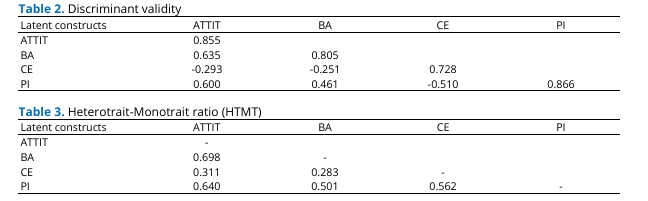
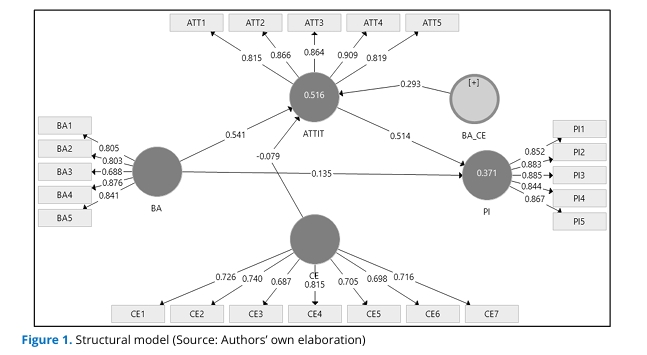
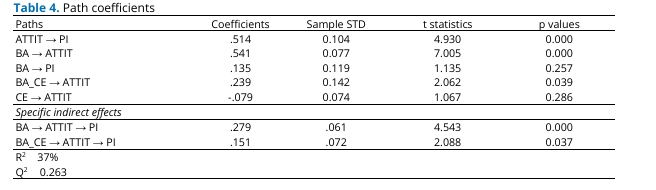
The establishment of discriminant validity is also confirmed by the values of HTMT (see Table 3). All the values are below the threshold of 0.85. Therefore, it is concluded that discriminant validity has been established (Hameed et al., 2022). Thus, we concluded that the latent factors represent distinct constructs. By looking at the analyzed results in Table 4 all the key hypothesized relationships show acceptable fit (R2 = 37%, Q2 = .263). Further, the relationship between Brand awareness and Purchase intention after the inclusion of Attitude as a mediator produces a non-significant result (β = 0.135, t= 1.135, p = >0.05), this finding suggests that Attitude mediates the hypothesized relationship. Further, we found that celebrity endorsement strengthens the relationship between Brand awareness and attitude (β = .239, t = 2.062, p = < 0.05), indicating
that Brand awareness in the presence of celebrity endorsement will develop a positive attitude that will positively affect purchase intention. The study empirically supports that Attitude is a causal mechanism between Brand awareness and
Purchase intention (β = .279, t = 4.543, p = < 0.05). Results of moderated mediation revealed that to develop a favorable attitude among consumers that may positively affect purchase intention marketing needs to consider the key role of celebrity endorsement on Brand Awareness, Attitude, and Purchase intention relationships (β = .151, t = 2.088, p = <0.05). The role of celebrity endorsement was further assessed by f22 effect size. Results suggest that the effect size of moderated mediation on the model R2 value is a medium (0.23)3. The theory of planned behavior and social influence are highly predictive in the context of this study, as the value of predictive relevance is above the threshold of zero (Chin, 1998).
Discussion
Brand awareness and purchase intention are the starting points for discussion, and the study discovered strong positive relationships between them. The result that brand awareness influences purchase intention is validated by prior research (Shahid et al., 2017). Consumers will be in a better position to decide whether to make a purchase when they are informed about the product or brand in the age of digital communication. Consumers with less understanding of brand awareness are likely to choose alternatives when brands do not focus on generating awareness about brands that truly form a buy intention (Cassar et al., 2021). Advertisements, which are used by companies to build brand awareness, have the most influence on consumers when they are well-made, well-narrated, and tell a compelling tale about the product. These elements surely will have an impact on consumers’ purchase inclinations (Dewi et al., 2020; Tsai, 2020). Customers’ purchase intentions are influenced by their brand awareness. A consumer with higher brand awareness is more likely to make larger purchases. Consumer brand preference and spending intentions are influenced by brand awareness, which also has an impact on how highly consumers regard a brand when they are aware of it. The study also discovered a strong connection between brand awareness and attitude. Before making a purchase, a customer’s attitude is extremely important since it tells marketers exactly what the customer wants and what they received, including whether or not it exceeded their expectations and how well the goods matched the image they had in mind. Therefore, having a positive attitude, and brand awareness play a significant role (Ramesh et al., 2019). Furthermore, the study found a significant relationship between attitude and purchase intention. If a consumer has a positive attitude toward a brand or product offering, they will become fully aware of it and will only purchase products from well-known, reliable brands, however, if the brand or product offering is unclear or falls short of expectations, they will have a negative attitude and their purchasing behavior will be affected (Coursaris et al., 2016). The positive attitude of customers leads to purchase intention (Kwon & Ahn, 2020). Consequently, the study found a mediating impact of attitude between brand awareness and purchase intention. It shows attitude is the predictor of intention, positive attitude leads to positive behavior and intentions Dwivedi, (2021). People who carefully analyze things act in a way that is compatible with the evidence that is provided to them through various channels, primarily brand awareness through social media applications, as mandated by Abima et al. (2021). Lastly, the study found a moderating impact of celebrity endorsement on the relationship between brand awareness and attitude. The hypothesis postulate is validated by the findings of the study. The celebrity’s endorsement of digital communication technology creates an attitude that has a direct impact on consumers’ intentions to make purchases. The online attractiveness of celebrities serves as an example of how attractiveness, one of the most important factors influencing the intention to purchase a good, works. This frequently takes place when the public perceives celebrities as being appealing, which promotes positive customer interaction (Osei-Frimpong et al., 2019). People follow celebrities from all over the world to learn more about the products and businesses they promote on social media and to get recommendations, comments, and advice. Therefore, being this the basic reason, celebrity endorsement found a significant moderating impact on shaping the attitude of customers. Our findings validated the application of both theoretical perspectives (theory of planned behavior and social influence) in consumer behavior literature in the age of digital communication.
Theoretical Implications
The theoretical contribution of the study is twofold that enriches the body of knowledge. Firstly, from a theoretical perspective the study measured the mediating impact of attitude between brand awareness and purchase intention, empirical evidence revealed that consumer attitude is a causal mechanism between Brand awareness and purchase intention in the age of digital communication. Further, the study contributes additional evidence from moderated mediational perspective. Taken together, these findings suggest that to develop a favorable attitude among consumer that positively affect purchase intention marketer needs to consider the key role of celebrity endorsement on Brand Awareness, Attitude, and Purchase intention relationships in the age of digital communication. Also, the buffering effect of moderated mediation extended the scope of TPB and the theory of social influence in the age of digital communication and media.
Managerial Implication
First off, the study has important management implications for companies that use digital communication and media technologies to market their products. If the product has established enough brand awareness in the market using various digital media technologies, it will be able to attract consumers’ attention, shape attitude, and influence them to make a purchase. Everything is moving online in this digital age, and this includes ads and online shopping too. Customers now have a wide range of media options to choose from, which gives rise to favorable brand awareness that leads to purchase intention. Second, advertising companies must comprehend that celebrity endorsement is crucial in influencing consumer attitudes, thus they must only take into account celebrities who are well-liked by the target market. Third, there are several social media platforms available to engage customers, so the brand must decide which one will give them access to the largest audience.
Limitations and Future Implications
The study can have numerous limitations along with future implications. Firstly, the study is conducted in five major cities of Pakistan thus in the future data from other big cities can be added for more generalizability. A survey study has been used in the current study consequently in the future some qualitative data can also be added about the nature of products and customers’ opinions as open-ended questions. Thirdly, the study can add various other factors such as social influence, personality factors, and culture to measure online purchase intention.
Conclusion
In general, the study began with the design of the research model through the analysis of pertinent literature and the formulation of research hypotheses that may provide the answers to the research questions. The study investigated the effect of brand awareness on purchase intention in the age of digital communication along with the mediating impact of attitude and moderating effect of celebrity endorsement in the relationship between brand awareness and attitude. The proliferation of technology in today’s world has led consumers to experience digital communication and shape their attitudes and intentions accordingly. The study confirmed the role of attitude as a mediator and celebrity endorsement as a moderator to strengthen the impact on purchase intention in the age of digital communication because individuals are compelled by the time to use technology and make intentions consequently.
Author contributions: All authors were involved in concept, design, collection of data, interpretation, writing, and critically revising the article. All authors approved the final version of the article.
Funding: The authors received no financial support for the research and/or authorship of this article.
Ethics declaration: Authors declared that the study did not require ethics committee approval since data was gathered from general consumers with their own willingness to participate. Authors further declared that this research paper is
the authors’ own original work, which has not been previously published elsewhere. The research paper is not currently being considered for publication elsewhere. The paper reflects the authors’ own research and analysis in a truthful and
complete manner. The responsibility of this statement shall be borne by the authors of the paper.
Declaration of interest: Authors declare no competing interest.
Data availability: Data generated or analysed during this study are available from the authors on request.
References
Ahmad, A., Malik, O. M., Hadi, N. U., & Gaadar, K. (2016). Barriers of online shopping in developing countries: Case study of Saudi Arabia. European Academic Research, 3(12), 12957-12971. Ahmad, A., & Hadi, N. U. (2020). Impact of digitization on consumer buying behavior with respect to consumer demographic factors. Foundation University Journal of Business & Economics, 5(1), 15-30. Abima, B., Engotoit, B., Kituyi, G. M., Kyeyune, R., & Koyola, M. (2021). Relevant local content, social influence, digital literacy, and attitude toward the use of digital technologies by women in Uganda. Gender, Technology and Development, 25(1), 87-111. https://doi.org/10.1080/09718524.2020.1830337 Ajzen, I. (1991). The theory of planned behavior. Organizational behavior and human decision processes, 50(2), 179-211. https://doi.org/10.1016/0749-5978(91)90020-T Akbari, M. (2015). Different impacts of advertising appeals on advertising attitude for high and low involvement products. Global https://doi.org/10.1177/0972150915569936 Business Review, 16(3), 478-493. Amaliah, R. R., Jusni, J., & Munir, A. R. (2020). The influence of lifestyle, motivation, perception and attitude toward the purchase decision of ecofriendly environment straw (Case study on the management students of Hasanuddin University). Hasanuddin Journal of Applied Business and Entrepreneurship, 3(2), 93-104. https://doi.org/10.26487/hjabe.v3i2.326 Apejoye, A. (2013). Influence of celebrity endorsement of advertisement on students’ purchase intention. Journal of Mass Communicatication & Journalism, 3(152), 2. https://doi.org/10.4172/2165-7912.1000152 Atkin, C., & Block, M. (1983). Effectiveness of celebrity endorsers. Journal of advertising research. equity Azzari, V., & Pelissari, A. (2020). Does brand awareness influences purchase intention? The mediation role of brand dimensions. https://doi.org/10.15728/bbr.2020.17.6.4 Brazilian Business Review, 17(6), 669-685. Cassar, M. L., Caruana, A., & Konietzny, J. (2021). Facts or story? The impact of website content on narrative believability and purchase intention. Journal of Marketing Communications, 1-20. https://doi.org/10.1080/13527266.2021.1929408 Chin, W. W. (1998). The partial least squares approach to structural equation modeling. Modern methods for Business Research, 295(2), 295-336. Chu, S. C., & Chen, H. T. (2019). Impact of consumers’ corporate social responsibility‐related activities in social media on brand attitude, electronic word‐of‐mouth intention, and purchase intention: A study of Chinese consumer behavior. https://doi.org/10.1002/cb.1784 Journal of Consumer Behaviour, Cohen, J. (1988). Statistical power analysis for the behavioral sciences (2nd ed.). Erlbaum. models. 18(6), 453-462. Corneille, O., & Stahl, C. (2019). Associative attitude learning: A closer look at evidence and how it relates to attitude Personality and https://doi.org/10.1177/1088868318763261 Social Psychology Review, 23(2), 161-189. Coursaris, C. K., Van Osch, W., & Balogh, B. A. (2016, January). Do Facebook likes lead to shares or sales? Exploring the empirical links between social media content, brand equity, purchase intention, and engagement. In 2016 49th Hawaii international conference on system sciences (HICSS) (pp. 3546-3555). IEEE. https://doi.org/10.1109/HICSS.2016.444 Dabbous, A., & Barakat, K. A. (2020). Bridging the online offline gap: Assessing the impact of brands’ social network content quality on brand awareness and purchase intention. Journal of Retailing and Consumer Services, 53, 101966. https://doi.org/10.1016/j.jretconser.2019.101966 Dewi, C. K., Mohaidin, Z., & Murshid, M. A. (2020). Determinants of online purchase intention: a PLS-SEM approach: Evidence from Indonesia. Journal of Asia Business Studies. https://doi.org/10.1108/JABS-03 2019-0086 Duffett, R. (2020). The YouTube marketing communication effect on cognitive, affective and behavioral attitudes Generation https://doi.org/10.3390/su12125075 Z consumers.
Sustainability, 12(12), 5075.
Febrian, A., & Fadly, M. (2021). Brand trust as celebrity endorser marketing moderator’s role. Jurnal Aplikasi Manajemen, 19(1), 207-216. https://doi.org/10.21776/ub.jam.2021.019.01.19
Ferdous, M. Z., Islam, M. S., Sikder, M. T., Mosaddek, A. S. M., Zegarra-Valdivia, J. A., & Gozal, D. (2020). Knowledge, attitude, and practice regarding COVID-19 outbreak in Bangladesh: An online-based cross sectional study. PloS One, 15(10), e0239254. https://doi.org/10.1371/journal.pone.0239254
Fornell, C., & Larcker, D. F. (1981). Structural equation models with unobservable variables and measurement error. Algebra and statistics. 382-388. https://doi.org/10.1177/002224378101800313
Foroudi, P. (2019). Influence of brand signature, brand awareness, brand attitude, brand reputation on hotel industry’s brand performance. International Journal of Hospitality Management, 76, 271-285. https://doi.org/10.1016/j.ijhm.2018.05.016
Ghosh, T., Sreejesh, S., & Dwivedi, Y. K. (2021). Examining the deferred effects of gaming platform and game speed of advergames on memory, attitude, and purchase intention. Journal of Interactive Marketing, 55, 52-66. https://doi.org/10.1016/j.intmar.2021.01.002 Gogoi, B. (2013), Study of antecedents of purchase intention and its effect on brand loyalty of private label brand of apparel, International Journal of Sales & Marketing, 3(2), 73-86.
Ha, N. M., & Lam, N. H. (2016). The effects of celebrity endorsement on customers’ attitude toward brand and purchase intention. International Journal of Economics and Finance, 9(1), 64-77.
https://doi.org/10.5539/ijef.v9n1p64 Hadi, N. U., Abdullah, N., & Santosa, I. (2016b). Making sense of mediating analysis: A marketing perspective.
Review of integrative Business & Economics, 5(2), 62-76. Journal Hadi, N. U. (2022). Specifying the Problem of Measurement Models Misspecification in Management Sciences Literature of International https://doi.org/10.36941/jicd-2022-0015 Cooperation and Development, 5(3), 91-100.
Hadi, N. U., & Aslam, N. (2023). Demographic factors and consumer attitude towards unsolicited mobile-based marketing messages: A factorial design. Online Journal of Communication and Media Technologies, 13(1), e202302. https://doi.org/10.30935/ojcmt/12784
Hair, J. F., Hult, G. T. M., Ringle, C. M., & Sarstedt, M. (2014). A primer on partial least squares structural equation modeling. Thousand Oaks: Sage. Hair, J. F., Ortinau, D. J., & Harrison, D. E. (2010). Essentials of marketing research (Vol. 2). McGraw-Hill/Irwin. Hameed, F., & Qayyum, A. (2018). Determinants of behavioral intention towards mobile learning in Pakistan:
Mediating role of attitude. https://doi.org/10.22547/BER/10.1.2 Business and Economic Review, 10(1), 33-61.
Hameed, F., Qayyum, A., & Khan, F. A. (2022). A new trend of learning and teaching: Behavioral intention towards mobile learning. Journal of Computers in Education. https://doi.org/10.1007/s40692-022-00252 w Hani, S., Marwan, A., & Andre, A. (2018). The effect of celebrity endorsement on consumer behavior: Case of the Lebanese jewelry industry. Arab Economic and Business Journal, 13(2), 190-196. https://doi.org/10.1016/j.aebj.2018.11.002
Huang, C. Y., Chou, C. J., & Lin, P. C. (2010). Involvement theory in constructing bloggers’ intention to purchase travel products. Tourism Management, 31(4), 513-526. https://doi.org/10.1016/j.tourman.2009.06.003
Hung, K., Chan, K. W., & Caleb, H. T. (2011). Assessing celebrity endorsement effects in China: A consumer celebrity relational approach. Journal of advertising research, 51(4), 608-623. https://doi.org/10.2501/JAR 51-4-608-623
Irshad, M., & Ahmad, M. S. (2019). Investigating the determinants of consumers attitude towards social media marketing: Moderating role of gender. Online Journal of Communication and Media Technologies, 9(4), e201920. https://doi.org/10.29333/ojcmt/5865
Kim, D. K., & Kim, M. (2016). Influence of brand awareness and brand attitude on purchase. Journal of Marketing Thought, 3(1), 16-27. Kim, S. H., & Seock, Y. K. (2019). The roles of values and social norm on personal norms and pro environmentally friendly apparel product purchasing behavior: The mediating role of personal norms. Journal of Retailing and Consumer Services, 51, 83-90. https://doi.org/10.1016/j.jretconser.2019.05.023 Kwon, J., & Ahn, J. (2020). The effect of green CSR skepticism on positive attitude, reactance, and behavioral intention. Journal of Hospitality and Tourism Insights. https://doi.org/10.1108/JHTI-05-2020-0074 Lee, E. B., Lee, S. G., & Yang, C. G. (2017). The influences of advertisement attitude and brand attitude on purchase intention of smartphone advertising. Industrial Management & Data Systems. https://doi.org/10.1108/IMDS-06-2016-0229 Malik, I. A., & Hadi, N. U. (2019). Inspirational factors of electronic word of mouth: A case of social networking sites. Journal of Managerial Sciences, 13(2), 253-254. McClure, C., & Seock, Y. K. (2020). The role of involvement: Investigating the effect of brand’s social media pages on consumer purchase intention. Journal of retailing and consumer services, 53, 101975. https://doi.org/10.1016/j.jretconser.2019.101975 Min, J. H. J., Chang, H. J. J., Jai, T. M. C. (2019). The effects of celebrity-brand congruence and publicity on consumer attitudes and buying behavior. Fash Text 6, 10 (2019). https://doi.org/10.1186/s40691-018 0159-8 The Nguyen, N. T. (2021). The influence of celebrity endorsement on young Vietnamese consumers’ purchasing intention. Journal of Asian Finance, https://doi.org/10.13106/jafeb.2021.vol8.no1.951 Economics and Business, 8(1), 951-960. Olmedo, A., Milner‐Gulland, E. J., Challender, D. W., Cugnière, L., Dao, H. T. T., Nguyen, L. B., & Veríssimo, D. (2020). A scoping review of celebrity endorsement in environmental campaigns and evidence for its effectiveness. Conservation Science and Practice, 2(10), e261. https://doi.org/10.1111/csp2.261 Osei-Frimpong, K., Donkor, G., & Owusu-Frimpong, N. (2019). The impact of celebrity endorsement on consumer purchase intention: An emerging market perspective. Journal of marketing theory and practice, 27(1), 103-121. https://doi.org/10.1080/10696679.2018.1534070 behavior Peña-García, N., Gil-Saura, I., Rodríguez-Orejuela, A., & Siqueira-Junior, J. R. (2020). Purchase intention and purchase online: A cross-cultural https://doi.org/10.1016/j.heliyon.2020.e04284 approach. Heliyon, 6(6), e04284. Rahman, M. T., Misbah, H. B. H., Shukor, S. B. A., & Mowla, M. (2021). Do celebrity endorsement and reputable companies TV ads effect on middle-class consumer purchase decision of fast-moving consumer goods? A study in Bangladesh. Review of International Geographical Education Online, 11(5), 3715-3736. https://doi.org/10.48047/rigeo.11.05.257 Ramesh, K., Saha, R., Goswami, S., & Dahiya, R. (2019). Consumer’s response to CSR activities: Mediating role of brand image and brand attitude. Corporate Social Responsibility and Environmental Management, 26(2), 377-387. https://doi.org/10.1002/csr.1689 Razak, N., Themba, O. S., & Sjahruddin, H. (2019). Brand awareness as predictors of repurchase intention: Brand attitude as a moderator. Advances in Social Sciences Research Journal, 6(2). https://doi.org/10.14738/assrj.62.6264 Sabirov, O. S., Berdiyarov, B. T., Yusupov, A. S., Absalamov, A. T., & Berdibekov, A. I. U. (2021). Improving ways to increase the attitude of the investment environment. Revista Geintec-Gestao Inovacao E Tecnologias, 11(2), 1961-1975. https://doi.org/10.47059/revistageintec.v11i2.1811 Sallam, M. A., & Algammash, F. A. (2016). The effect of attitude toward advertisement on attitude toward brand and purchase intention. International Journal of Economics, Commerce and Management, 4(2), 509-520. Santoso, A., Bidayati, U., & Hendar, H. (2019). Factors influencing online purchase intention: A consumer behavioral study on Indonesia. Saputro, Y., & Prihandono, D. (2018). Television advertising effectiveness in mediating advertising creativity and advertising frequency influence toward customer purchase intention. Management Analysis Journal, 7(2), 201-210. Sasmita, J., & Suki, N. M. (2015). Young consumers’ insights on brand equity: Effects of brand association, brand loyalty, brand awareness, and brand image. International journal of retail & distribution management. https://doi.org/10.1108/IJRDM-02-2014-0024 Saydan, R., & Dülek, B. (2019). The impact of social media advertisement awareness on brand awareness, brand image, brand attitude and brand loyalty: A research on university students. International Journal of Contemporary Economics https://doi.org/10.5281/zenodo.3596116 and Administrative Sciences, 9(2), 470-494. Schafer, R. (2019). The analytic attitude. Routledge. https://doi.org/10.4324/9780429481024 Shah, H., Aziz, A., Jaffari, A. R., Waris, S., Ejaz, W., Fatima, M., and Sherazi., K. (2012). The impact of brands on consumer purchase intentions. Asian Journal of Business Management 4(2), 105-110 Shahid, Z., Hussain, T., & Zafar, F. (2017). The impact of brand awareness on the consumers’ purchase intention. Journal of Marketing and Consumer Research, 33(3), 34-38. Industrial Sharma, A., Mehtab, R., Mohan, S., & Shah, M. K. M. (2021). Augmented reality–an important aspect of Industry 4.0. Robot: the international journal of robotics research and application. https://doi.org/10.1108/IR-09-2021-0204 Singh, R. P., & Banerjee, N. (2018). Exploring the influence of celebrity credibility on brand attitude, advertisement attitude and purchase intention. Global Business Review, 19(6), 1622-1639. https://doi.org/10.1177/0972150918794974 Surana, R. (2008). The effectiveness of celebrity endorsement in India [Master’s thesis, The University of Nottingham]. Tariq, M., Abbas, T., Abrar, M., & Iqbal, A. (2017). EWOM and brand awareness impact on consumer purchase intention: mediating role of brand image. Pakistan Administrative Review, 1(1), 84-102. Thomas, M. J., Wirtz, B. W., & Weyerer, J. C. (2019). Determinants of online review credibility and its impact on consumers’ purchase intention. Journal of Electronic Commerce Research, 20(1), 1-20. Thomas, T., Singh, N., & Ambady, K. G. (2020). Effect of ethnocentrism and attitude towards foreign brands in purchase decision. Vision, 24(3), 320-329. https://doi.org/10.1177/0972262919867509 Tsai, M. C. (2020). Storytelling advertising investment profits in marketing: From the perspective of consumers’ purchase intention. Mathematics, 8(10), 1704. https://doi.org/10.3390/math8101704 Venkateswara Rao, M. K., & Elavarasan, R. (2022). Role of brand equity in the purchase intention-a study with reference to FMCG consumers in chennai city. Specialusis Ugdymas, 1(43), 1207-1216. Wedel, M., Bigné, E., & Zhang, J. (2020). Virtual and augmented reality: Advancing research in consumer marketing. International Journal of https://doi.org/10.1016/j.ijresmar.2020.04.004 media Research in Marketing, 37(3), 443-465. Yang, R., & Chee, T. (2020). Do social ties matter for purchase frequency? The role of buyers’ attitude towards social marketing. Computers https://doi.org/10.1016/j.chb.2020.106376 in Human Behavior, 110, 106376. Yang, W. (2018). Star power: the evolution of celebrity endorsement research. International Journal of Contemporary Hospitality Management. https://doi.org/10.1108/IJCHM-09-2016-0543 Younus, S., Rasheed, F., & Zia, A. (2015). Identifying the factors affecting customer purchase intention. Global Journal of Management and Business Research. Zafar, A. U., Shen, J., Ashfaq, M., & Shahzad, M. (2021). Social media and sustainable purchasing attitude: Role of trust in social media and environmental effectiveness. Journal of Retailing and Consumer Services, 63, 102751. https://doi.org/10.1016/j.jretconser.2021.102751 Zhang, H., Xu, H., & Gursoy, D. (2020). The effect of celebrity endorsement on destination brand love: A comparison of previous visitors and potential tourists. Journal of Destination Marketing & Management, 17, 100454. https://doi.org/10.1016/j.jdmm.2020.100454 Zipporah, M. M., & Mberia, H. K. (2014). The effects of celebrity endorsement in advertisements. International Journal of Academic Research in Economics and Management Sciences, 3(5), 178. https://doi.org/10.6007/IJAREMS/v3-i5/1250.
Appendix A
Brand Awareness
I am aware of this particular product/brand that appeared on social media.
I can recognize this particular product/brand in comparison with the other competing products/brands that appeared on social media.
I know what this particular product/brand looks like.
Some characteristics of the particular product/brand that appeared on social media come to my mind quickly.
I can quickly recall the symbol or logo of the particular product/brand that appeared on social media.
Attitude
I like the brand’s social media sites.
I think the brand’s social media sites are reliable.
I think the brand’s social media sites are friendly.
I think the brand’s social media sites are valuable.
I think the brand’s social media sites are of good quality.
Celebrity Endorsement
Celebrities in consumer goods ads are usually well-known faces.
Attractive celebrities are endorsed in consumer goods ads.
I believe that products endorsed by celebrities are their favorite brands.
I trust celebrities endorsed in consumer goods ads.
I follow on social media a consumer goods brand that is endorsed by a celebrity.
Celebrity endorsers encourage my purchase decision.
I trust consumer goods brands that are endorsed by celebrities.
Purchase Intention
I will buy products that are advertised on social media in the near future.
I desire to buy products that are promoted on social media.
Advertisements on social media have a positive influence on my purchase decision.
I would buy the products that are advertised on social media if I had the money.
I am likely to purchase some of the products that are advertised on digital media.