
Effect of Dimensions of Advertising on Behavioral Intentions of Customers
Farhina Hameed & Younus Awan
Farhina Hameed & Younus Awan. (2017). Effect of Dimensions of Advertising on Behavioral Intentions of Customers, Pakistan Business Review, 19(1), 138-156.
Abstract
Marketers use diverse strategies to persuade customers in order to maximize their sales. Billions of dollars are dedicated every year on diverse promotional activities. Among all, advertising plays an important role in informing customers. The aim of the study is to measure the impact of advertising dimensions on behavioral intention of customers. It measures the mediating and moderating role in describing behavioral intentions. Systematic sampling technique is applied, data is collected from students and sample size is 272 cellular users. Multiple Regression analysis and Barons and Kenny’s method to test moderation and mediation is applied. All variables showed a positive impact on behavioral intentions except innovativeness. The study exhibits partial mediation and weak moderation effect. Managerial, academic and future implications are also discussed.
Keywords: Advertising dimensions, Behavioral intention, Brand trust, Pakistan, Perceived value
Introduction
The behavioral intention of the customers primarily represents the repurchase intentions. Zeithaml et al. (1996) suggest
five behavioral intention dimensions that include positive word of mouth (WOM), recommend to others, remain loyal or repurchase, spend more with company and willingness to pay more to the company. To induce customers, different strategies are being used by the marketers and organizations dedicate specific amount for promotional activities and among all, advertising is paramount tool to create awareness. Marketers use different dimensions in advertising in order
to influence customers. Companies are facing rigid competition, due to high saturation in the market. Hence, customer retention is the basic objective of every firm and strong advertisement has the ability to change the attitude of the customers.Different advertising dimensions are being studied by the marketers in order to create an impact on customers includes: relevant news, familiarity, empathy, brand reinforcement and confusion (Schlinger, 1979).
The use of humor is one of the common practices done by the companies nowadays. About one, out of five TV advertisements holds humorous impression/appeal (Beard, 2005). Brand awareness is the main purpose of every company in the market. Beside creating awareness and showing existence, companies spend millions on advertisements to inform people about product, its features and offerings (Clark et al. 2009). Infotainment is the major concern because
customers need full information regarding product/brand and entertainment beside information. Entertainment in advertising shows that advertising is fun, enjoyable, and pleasurable to watch (Schlinger, 1979).Moreover, the credibility of advertisement and information plays crucial role in attracting and retaining customers. Trustworthiness implies that brand is willing to deliver what it promises whereas expertise entails, brand is capable of delivering what it promises (Wang
& Yang, 2010). The new millennium has brought a revolution in Telecom sector of Pakistan by changing the whole landscape. It is facing a lot of challenges and is working in highly competitive environment. Due to high saturation, it is becoming difficult for the companies to capture new customers or to retain existing customers. The present study
focuses on advertisements shown by Telecom companies of Pakistan and is conducted to give comprehensive review regarding the factors which can impact effectiveness of advertisements and makes organizations knowledgeable regarding advertising dimensions which can influence customers to take action against their advertisements and induce organizations to make an advertisement attractive that creates real output. The cellular users are discussed for the first time in Pakistan, because they can better explain the influence of advertisement on their behavioral intentions. The objective of the study is: to measure the direct effect of advertising dimensions on behavioral intentions, to measure the indirect effect of advertising dimensions on behavioral intention via perceived value, to examine the effect of advertising dimensions on perceived value, to measure the mediating impact of perceived value on the relationship between advertising dimensions and behavioral intentions and to find out the moderating effect of brand trust on the relationship between perceived value and behavioral intentions.
Literature Review
Behavioral Intention
The positive attitude of the customers towards product symbolizes positive effect on the intention to purchase. Wang & Sun
(2010) examined the consequence of satisfaction and service quality on three consumer behavior intention aspects which included: word of mouth, site revisit and purchase intention. The results found that quality has a positive impact on satisfaction which directly or indirectly affects the behavioral intention of customers. Specifically, Zeithaml et al. (1996) suggested five behavioral intention dimensions such as: say positive things about company/brand (positive WOM),
recommend to other consumers, pay price premiums (willingness to pay more), remain loyal to them (i.e., repurchase from them) and spend more with the company. Moreover, in several studies, willingness to recommend, positive word of mouth and repurchase intentions were taken to measure customer’s behavioral intentions (Ozdemir& Hewett, 2010).
Advertising Dimensions
Humor is one of the frequently used arousing appeals. Common practice of today’s advertising is inducing humor in the
ads; one, out of five TV ads shows humorous appeals (Beard, 2005). The uses and gratifications (U&G) theory has been productive in providing a thoughtful understanding of apprehension and consumer’s motivations in the context of traditional media, such as television and radio (Eighmey& McCord 1998). The investigation of consumer’s perspectives of m-advertising value can thus be viewed as an extension of U&G theory. Following previous research (Wang & Sun, 2010), entertainment and informativeness are incorporated into a single construct (infotainment) in the study. The personality of
the individual is basically influenced by the humor styles such as: affiliative, self-enhancing, aggressive and self-defeating (Kuiper &Leite, 2010). Marketers use humorous advertising not only to inform but to entertain customers as well. The countries with low uncertainly avoidance, customers are more inclined towards humors ads as compared to countries with high uncertainty avoidance (Hatzithomas et al. 2011).
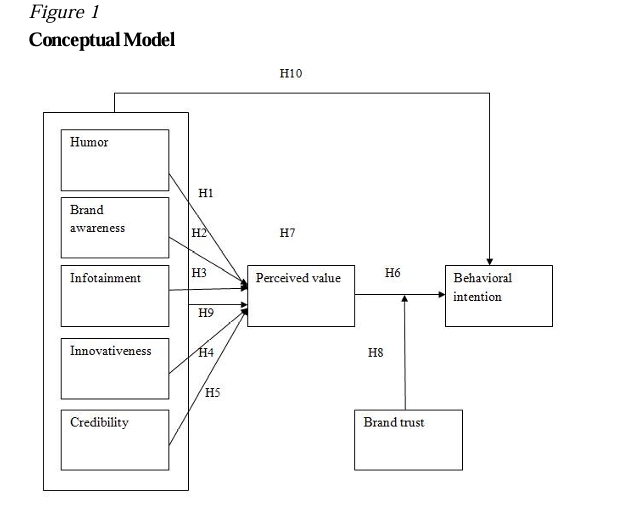
H1: Humor in advertising has a positive and significant impact on perceived value.
In memory theory, brand awareness is positioned as an imperative step in structure the “bundle” of relations which are
attached to the brand in memory (Stokes, 1985). The key element of marketing strategy is to develop and maintain strong brands (Keller & Lehmann, 2006). Brand awareness plays imperative role in branding strategies, due to this most of the company’s focus their branding activities on the distribution of brand name and logo irrespective of the development of identity of the brand (Wang & Sun, 2010).
H2: Brand awareness in advertising has a positive and significant impact on perceived value. Infotainment is derived from two words i.e. information and entertainment. Advertisements intend to provide information to the customers and associate value as need satisfaction. According to the marketers, the information provided in advertising messages is valuable for the recipients. However, Wang & Sun, (2010) identified that some of the marketers adopt humor approach in order to deliver messages to the customers. Consumers find these messages not only informative but also entertaining (Petrovici & Marin). The information provided to customers should have accuracy, truthfulness and usefulness in order to increase the impact of advertisement on an individal (Baek& King, 2011). Entertainment is also the basic aspect of advertisment beside information. The feeling of pleasure and enjoyment of the cutomers after watching the advertisement plays crucial role in
developing positive attitude.
H3: Infotainment in advertising has positive and significant impact on perceived value. The creativity in advertising is measured via different models in early researches and found that advertising creativity have positive influence on customers (Nyilasy et al. 2013). Theory of Diffusion of Innovations that inquire about how, why, and at what rate new ideas and technology spread through cultures. Everett Rogers, in his first book that was published in 1962, professor of communication studies, popularized the theory in his book called “Diffusion of Innovations”. The book explains that diffusion is the procedure through which an innovation is communicated via certain channels over time amongst the members of a social system. Diffusion of innovations theory origins are diverse and span multiple disciplines (Rogers, 2003). The innovative advertising always has a strong influence on customers mind either it is TV ad or mobile ad. It plays imperative role in shaping the purchase intentions of customers (Hameed et al. 2016).
H4: Innovativeness in advertising has a positive and significant impact on perceived value.
Credibility and perceived value are two vital components to study behavioral intention of customers. The credibility of brand affects the purchase intention of customers. It positively influence purchase intentions via perceived quality and perceived risk (Baek et al. 2010). It’s a long standing inquiry for marketers to understand the mechanism of brand credibility. It is found that brand credibility has strongest impact on purchase intention of customers with the increase
perceived value (Baek& King, 2011). Nowadays, brands need to associate with values that distinguish from one another. The
credibility in messages delivered to customers influence customer behavior (Nyilasy et al. 2013).
H5: Credibility in advertising has a positive and significant impact on perceived value.
Perceived value is described as consumer’s overall assessment of the utility of a product or service based on perceptions
of what is received and what is given (Zeithaml et al. 1996). Different attributes of service quality influence perceived value of customers and significantly influence functional and symbolic dimensions (Chen & Hu, 2010). It plays imperative role in building the loyalty towards the brand (Hameed, 2013). The roots of perceived value is in equity theory that represents the exchange among benefits that customer receives and cost includes financial, time and energy that customer bring upon himself via use of certain product or brand. Consequently, for determining customer value, quality of service is the indicator. Therefore, customer satisfaction index (CSI) model described that value perception is directly influenced by perceived service quality (Lee, 2011).
H6: Perceived value has a positive and significant impact on behavioral intentions.
H7: Perceived value mediates the relationship between advertising dimensions and behavioral intentions. Brand Trust Kuan& Bock (2007) investigated the factors affecting the formation of online trust for consumers of a brick and mortar supermarket retailer. Therefore, without building trust of the brand, it is not possible for the organizations to remain in the market or to get competitive edge. Thus consumer’s commitment to a brand would be the consequence of his trust in it (Baek& King, 2011). Privacy plays important role in building behavioral intentions of the customers and the study found that trust plays critical role in predicting consumer intention to purchase. In brand management strategy, trust is an essential component (Chen & Hu, 2010) and is vital factor in today’s business settings to institute a strong relationship among consumers and brand.
H8: Brand trust moderates the relationship between perceived quality and behavioral intentions.
H9: Advertising dimensions have a positive and significant impact on perceived value.
H10: Advertising dimensions have a positive and significant impact on behavioral intentions.
The gap is identified on the basis of extensive review of literature and it includes dimensions such as: relevant news, familiarity, empathy, brand reinforcement and confusion (Schlinger, 1979). But the present study added new dimensions that were extracted from past literature include: humor, brand awareness, infotainment, innovativeness and credibility (Usman, 2013; Zeithaml et al. 1996; Boorzoei&Asgari, 2013; Ha & Jang, 2010). Previous studies studied dimensions of advertising but present study creates value in literature by studying above mentioned dimensions. Moreover, brand trust is always studied as mediator (Zehir et al. 2011) but in present study its effect on behavioral intention is measured as moderator. The conceptual model for explaining the relationship among variables and their interdependencies is presented as follows:
Methods
48 items are distributed amongst the target variables of study. 5 items for humor is developed on the basis of extensive literature review. 5 items of brand awareness is adapted from Aaker (1991); Srull (1984). 5 items of infotainment is adapted from Ducoffe’s (1996). 9 items of innovativeness is adapted from Smith et al. (2007). 6 items of credibility is adapted from Hanzaee & Taghipourian, (2012). 5 items of perceived value is adapted from Choi et al. (2004); Sengupta & Johar (2002). 7 items of brand trust is adapted from Morgan & Hunt, (1994). 6 items of behavioral intention is adapted from Zeithaml et al. (1996); Sengupta & Johar, (2002).Systematic sampling technique is executed to draw sample from four universities of twin cities Rawalpindi and Islamabad and sample size was 272 individuals. Students were opted to measure the impact of advertising on behavioral intentions because they are more inclined towards using cellular services and watching advertisements of Telecom companies. Total 400 questionnaires distributed in order to get enough number of responses and to run analysis. 272 questionnaires were received back in time span of two months and response rate of the study was 68%. Multiple Regression Analysis is conducted and Barron and Kenny’s (1986) method is used to measure moderation and mediation effect.
Results
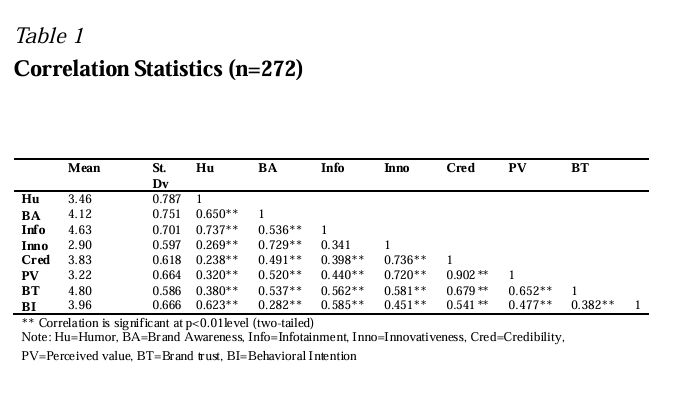
Before starting analysis, normality of data is checked thus shows data is normally distributed. The value of Cronbach’s alpha for composite scale is 0.88, therefore, data is reliable. Pearson correlation is performed to check association among variables of interest (Younus & Hameed, 2014)
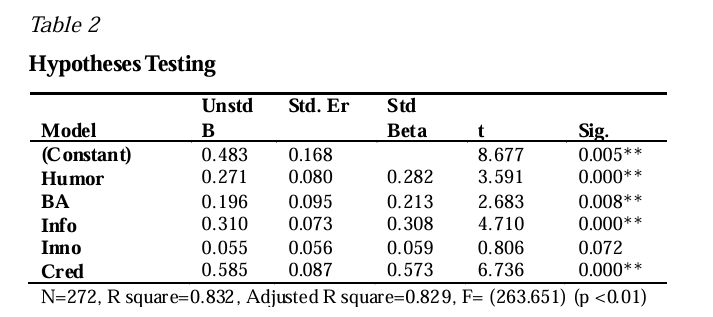
Five variables were regressed on dependent variable which is perceived value. The value of R square shows that 83% deviation is explained by five independent variables. A beta value shows the contribution of predictors in explaining the dependent variable if this value is less than 0.05 than variable is making a significant contribution and vice versa. H1, H2, H3 and H5 hypotheses are accepted because t values of beta coefficients are 3.591, 2.683, 4.710 and 6.736 which represent highly significant values thus are accepted whereas, H4 is rejected because its beta coefficient has insignificant t value=0.072.
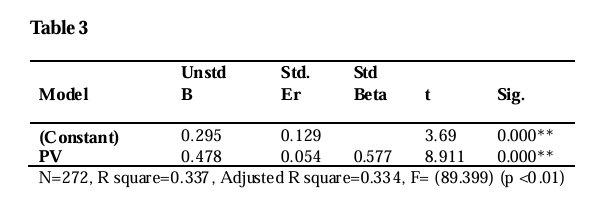
To check hypothesis H6, perceived value is regressed on behavioral intention. The results showed that R square value is0.337,it means 34% variation in behavioral intention variable is explained by predictor. The hypothesis is accepted because beta coefficient t value is 8.911 which is highly significant.
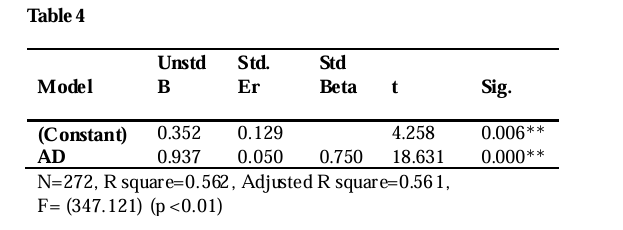
The results illustrates that R square value is 0.562, means 56% variation in perceived value variable is explained by predictor. The hypothesis is accepted because beta coefficient t value is 18.631 which is highly significant and states that advertising dimensions has significant impact on perceived value, hence, accepts H9.
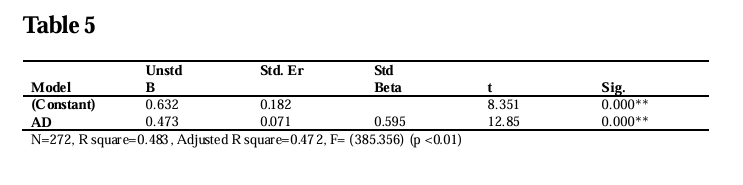
The results showed that R square value is 0.483, means 48% variation in customer’s behavioral intention variable is explained by independent variable. The hypothesis is accepted because beta coefficient t value is 12.85 which is highly significant and states that advertising dimensions has significant impact on behavioral intention, therefore accepts H10.
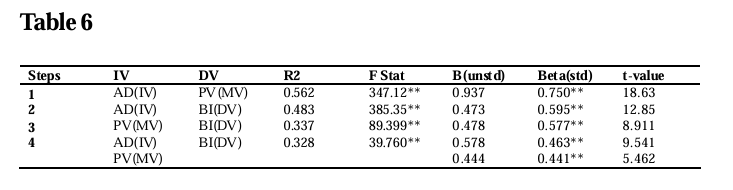
In order to check mediation, Baron’s and Kenny’s (1986) four steps are applied and assumptions must be fulfilled. The first
step indicates that model is significant because of beta coefficient t value=18.63, R square=0.562 and standardized beta coefficient 0.750. The R square value described that 56% variation in criterion is caused by predictor and standardized beta coefficient value explains that 75% contribution in explaining the relationship. For second mediation step, beta coefficient t-value=12.85, R square=0.483 and standardized beta coefficient 0.595. The R square value described that 48% variation in criterion is caused by predictor and standardized beta coefficient value explains that 59% contribution in explaining the relationship. As far as third step of mediation is concerned, beta coefficient t value=8.911, R square=0.337 and standardized beta coefficient 0.577. The R square value described that 34% variation in criterion is caused by predictor and standardized beta coefficient value explains that 57% contribution in explaining the relationship. Lastly, the beta coefficient t-value of advertising dimensions with behavioral intention is significant that is 9.541 and beta coefficient t value of perceived value with behavioral intention is 5.462. This clearly illustrate that mediation exist but partial mediation because t value of advertising dimensions with behavioral intention is significant and greater than t-value of perceived value and behavioral intention. Thus, direct effect is more significant as compared to indirect effect, however partial mediation exists. Hence accepts H7.
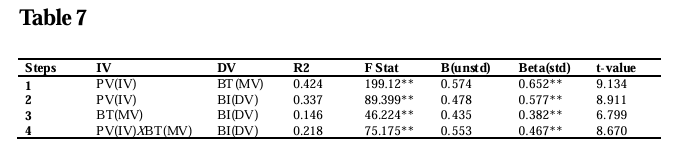
In order to check moderation, Baron’s and Kenny’s (1986) four steps are applied. Before performing moderation analysis, Barron’s and Kenny’s assumptions must be fulfilled that is significant relationship between IV-DV, IV-MV and MV-DV (first three steps). In this case assumptions are fulfilled and moderation analysis runs by entering IV and MV product (Interaction term) as independent variable. Step 4 in Table 7 shows significant relationship, thus explains that moderation exist between perceived value and behavioral intention. The value of R square and Beta for Interaction term is small t = 8.670, R square = 0.218 as compared to direct relationship between perceived value and behavioral intention t = 8.911, R square = 0.337, thus shows weak moderation exist hence accepts H8. So, future research is recommended to check the impact of moderator on dependent variable.
Discussion
The rationale of the study was to scrutinize the effect of advertising dimensions on customer’s behavioral intention and
perceived value. The findings of the study described that humor has significant effect on perceived value and behavioral intention. When the ads contain humorous aspect than perception of the customers builds in positive way. Besides, brand awareness, infotainment and credibility of advertising positively influence customer’s perceived value. The information provided to customers should have accuracy, truthfulness and valuable in order to increase the impact of an ad on an individal. The credibility of brand affects the purchase intention of customers. It positively influence purchase intentions via perceived quality and perceived risk (Baek et al. 2010).On the other hand, innovativeness has no significant impact on perceived value. The reason might be respondents are confused about innovative factor that either innovativeness in product/brand Company is offering or innovativeness in designing an ad. Innovativeness is explained as the perception of customers regarding novelty, creativity and uniqueness. The customer’s experiences and emotions must be taking into account in explaining perception (Kunz et al. 2011). So it can be the reason that’s why they are not confirmed and gave their opinion in neutral form. Besides, innovativeness in the advertisements does not have significant impact on behavioral intention rather advertisement should emphasize on the features of the product. The product should hold innovative aspects for high perceived value.
Moreover, advertising dimensions has positive impact on behavioral intention. As the humor, infotainment, credibility and brand awareness increases, positive behavioral intention of the customers builds. Advertising is considerd as dynamic tool that affect the brand awareness and quality perception of customers regarding brand and product (Clark et al. 2009). The feeling of pleasure and enjoyment of the cutomers after watching the advertisement plays crucial role in developing positive attitude.Brand credibility has strongest impact on purchase intention of customers with the increase of perceived
value (Baek& King, 2011) and nowadays, brands need to associate with values that distinguish from one to another. The credibility in messages delivered to customers influence customer behavior (Nyilasy et al. 2013). Furthermore, the finding of the study showed that perceived value mediates the association among advertising dimensions and behavioral intention but partial mediation exists. The main reason is that there are no or less researches who have investigated the same model and mediation effect. The customers who have more brand awareness about the brand, watched ad that is humorous and the information provided in an ad is credible are more inclined towards purchasing the product thus, have positive behavioral intentions.
In addition to this, the study found weak moderation effect of brand trust on the association between perceived value and
behavioral intentions. It might be because people have trust on certain brands but they never relate brand trust with perceived value because trust is complete phenomena.
Theoretical and Future Implications
The study provides imperative managerial implication for service organizations who attempts to manage advertising
effectiveness. Companies should focus on different dimensions of advertising to create an impact on customers and induce positive behavioral intentions. The present study is an attempt in understanding which factors; companies should be kept in mind in order to design advertisement. The compelling advertisement not only creates brand awareness but also assist in getting competitive edge.
Moreover, it provides academic implications because study of moderation and mediation added value in literature. It gives new insight about effect of advertising dimensions on behavioral intentions. The present study is focused towards cellular users for the first time in Pakistan who are exposed towards advertisements shown by Telecom Companies. Future research can replicate same model for generalization of results. Beside this, similar model can be tested in other industries to validate results. The study has some limitations regarding collection of data and customers non understanding regarding advertising dimensions.
References
Aaker, D. A. (1991).Measuring brand equity across products and markets.California Management Review, 38(3), 103.
Awan, M. Y., &Hameed, F. (2014).The Effect of Demographic, Socio economic and Other Characteristics on Donations. Current
Research Journal of Social Sciences, 6(2), 55-76.
Baek, T. H., & King, K. W. (2011).Exploring the consequences of brand credibility in services. Journal of Services Marketing, 25(4), 260-272.
Baek, T. H., Kim, J., & Yu, J. H. (2010). The differential roles of brand credibility and brand prestige in consumer brand choice. Psychology & Marketing, 27(7), 662-678.
Beard, F. K. (2005). One hundred years of humor in American advertising. Journal of Macro marketing, 25(1), 54-65.
Borzooei, M., &Asgari, M. (2013). The Halal brand personality and its effect on purchase intention. Interdisciplinary Journal of
Contemporary Research in Business, 5(3).
Chen, P. T., & Hu, H. H. (2010). How determinant attributes of service quality influence customer-perceived value: an empirical investigation of the Australian coffee outlet industry. International Journal of Contemporary Hospitality Management, 22(4), 535-551.
Choi, K. S., Cho, W. H., Lee, S., Lee, H., & Kim, C. (2004). The relationships among quality, value, satisfaction and behavioral intention in health care provider choice: a South Korean study. Journal of Business Research, 57(8), 913-921.
Clark, C. R., Doraszelski, U., &Draganska, M. (2009). The effect of advertising on brand awareness and perceived quality: An
empirical investigation using panel data. 7(2), 207-236.
Ducoffe, Robert, H. (1996), How Consumers assess the value of advertising, Journal of Current Issues & Research in
Advertising, 17(1), 1-18. Eighmey, J., & McCord, L. (1998).Adding value in the information age: Uses and gratifications of sites on the World Wide Web. Journal of Business Research, 41(3), 187-194. Ha, J., & Jang, S. (2010). Perceived values, satisfaction, and behavioral intentions: The role of familiarity in Korean restaurants. International Journal of Hospitality Management, 29(1), 2-13.
Hameed, F. (2013). The effect of advertising spending on brand loyalty mediated by store image, perceived quality and customer satisfaction: A case of hypermarkets. Asian Journal of Business Management, 5(1), 181-192.
Hameed, F., Rehman, H., &Awan, Y. (2016).Measuring the determinants of consumer perception regarding mobile advertising in Pakistan: a comparison between private and public sector universities. Science International, 28(1).
Hanzaee, K. H., &Taghipourian, M. J. (2012). The effects of brand credibility and prestige on consumers purchase intention in
low and high product involvement.
Hatzithomas, L., Zotos, Y., &Boutsouki, C. (2011). Humor and cultural values in print advertising: a cross-cultural study. International Marketing Review, 28(1), 57-80.
Keller, K. L., & Lehmann, D. R. (2006). Brands and branding: Research findings and future priorities. Marketing Science, 25(6), 740 759.
Kuan, H. H., & Bock, G. W. (2007). Trust transference in brick and click retailers: An investigation of the before-online-visit
phase. Information & Management, 44(2), 175-187.
Kuiper, N. A., &Leite, C. (2010). Personality impressions associated with four distinct humor styles. Scandinavian Journal of
Psychology, 51(2), 115-122.
Kunz, W., Schmitt, B., & Meyer, A. (2011). How does perceived firm innovativeness affect the consumer?. Journal of Business
Research, 64(8), 816-822.
Lee, J., Park, D. H., & Han, I. (2011). The different effects of online consumer reviews on consumers’ purchase intentions
depending on trust in online shopping malls: An advertising perspective. 21(2), 187-206. Wang, B., & Yang, S. (2010). A study on factors that affect users’ behavioral intention to transfer usage from the offline to the online channel. Computers in Human Behavior, 27(1), 355 364.
Nyilasy, G., Canniford, R., &Kreshel, P. J. (2013).Ad agency professionals’ mental models of advertising creativity. European Journal of Marketing, 47(10), 1691 1710
Ozdemir, V. E., & Hewett, K. (2010). The effect of collectivism on the importance of relationship quality and service quality for
behavioral intentions: a cross-national and cross-contextual analysis. Journal of International Marketing, 18(1), 41-62.
Petrovici, D., &Marinov, M. (2007). Determinants and antecedents of general attitudes towards advertising: A study of two
EU accession countries. European Journal of Marketing, 41(3/4), 307-326.
Schlinger, M. J. (1979). A profile of responses to commercials. Journal of Advertising Research, 19(2), 37-46. Sengupta, J., &Johar, G. V. (2002). Effects of inconsistent attribute information on the predictive value of product attitudes: Toward a resolution of opposing perspectives. Journal of Consumer Research, 29(1), 39-56.
Sheth, J. N., Mittal, B., & Newman, B. (1999). Consumer behavior and beyond.NY: Harcourt Brace.
Smith, R. E., MacKenzie, S. B., Yang, X., Buchholz, L. M., & Darley, W. K. (2007). Modeling the determinants and effects of creativity in advertising.Marketing Science, 26(6), 819-833.
Srull, T. K. (1984). Methodological techniques for the study of person memory and social cognition. Handbook of Social
Cognition, 2, 1-72.
Stokes, RC (1985).The Effects of Price, Package Design, and Brand Familiarity on Perceived Quality. In J Jacoby & J Olson (eds.). Perceived Quality. Lexington: Lexington Books. Rogers, E. M. (2003). Diffusion of innovations (5th edition). New York,
NY: Free Press.
Usman, M. (2013).Creation of Effective Advertising in the Persuasion of Target Audience. International Journal, 2(1).
Wang, Y., & Sun, S. (2010). Examining the role of beliefs and attitudes in online advertising: A comparison between the USA and Romania. International Marketing Review, 27(1), 87-107.
Zehir, C., Þahin, A., Kitapçý, H., &Özþahin, M. (2011).The effects of brand communication and service quality in building brand
loyalty through brand trust; the empirical research on global brands. Procedia-Social and Behavioral Sciences, 24, 1218
1231.
Zeithaml, V. A., Berry, L. L., &Parasuraman, A. (1996).The behavioral consequences of service quality. The Journal of Marketing,
31-46.
Usman, M. (2013).Creation of Effective Advertising in the Persuasion of Target Audience. International Journal, 2(1).
Wang, Y., & Sun, S. (2010). Examining the role of beliefs and attitudes in online advertising: A comparison between the USA and Romania. International Marketing Review, 27(1), 87-107.
Zehir, C., Þahin, A., Kitapçý, H., &Özþahin, M. (2011).The effects of brand communication and service quality in building brand
loyalty through brand trust; the empirical research on global brands. Procedia-Social and Behavioral Sciences, 24, 1218
1231.
Zeithaml, V. A., Berry, L. L., &Parasuraman, A. (1996).The behavioral consequences of service quality. The Journal of Marketing,
31-46